How businesses appear in ChatGPT: a 2026 guide
11 July 2026 · 3 min read
How businesses appear in ChatGPT: a 2026 guide

Business visibility in ChatGPT is earned through AI-recognised digital entity signals and credible content, not through any directory listing or paid placement. There is no official listing process for ChatGPT. Instead, the model surfaces brands it can verify across multiple authoritative sources. With 51% of B2B buyers now starting research in AI chatbots more often than Google, understanding how businesses appear in ChatGPT has become a practical marketing priority, not a technical curiosity.
How does ChatGPT decide which businesses to show?
ChatGPT answers commercial queries through two distinct lanes. The first is its base model, trained on large volumes of web content up to a knowledge cut-off date. The second is live web retrieval, which pulls real-time results from Bing’s search index. Both lanes rely on entity recognition: ChatGPT needs to confirm that your business is a real, consistent, and credible entity before it will mention or cite you.
The competitive dynamics are stark. ChatGPT surfaces only 3–4 brands per response on average. That means most businesses in any given category simply do not appear, regardless of how long they have traded or how good their service is. Live retrieval triggers in roughly 53% of commercial queries, compared with 18.7% for informational ones. Commercial intent queries are therefore the highest-value target for any business trying to improve its ChatGPT presence.

The model does not treat all mentions equally. Being named in an answer is different from having a URL cited, and both differ from being directly recommended as a vendor. Each outcome requires a different approach, and most businesses conflate them. Understanding the distinction is the starting point for any serious visibility effort.
Pro Tip: Query ChatGPT directly with your category and location, for example “best plumbers in Manchester,” and note whether your business appears, is cited with a URL, or is absent entirely. That audit takes five minutes and tells you exactly where you stand.
Why structured data and entity consistency matter
ChatGPT builds confidence in a business by cross-referencing its name, description, location, and services across multiple platforms. When those signals match, the model treats the business as a verified entity. When they conflict, it either omits the business or, worse, generates inaccurate information about it. Inconsistent NAP data across third-party sites is a leading cause of AI hallucinations about brands.
The platforms that carry the most weight for entity recognition include:
- LinkedIn company pages with a complete description, industry tags, and regular posts
- Crunchbase profiles with accurate founding date, location, and service categories
- Google Business Profile with consistent trading name and address
- Industry review platforms such as Trustpilot or sector-specific directories
- Schema.org markup on your own website, specifically Organisation and LocalBusiness types
Schema markup on your website is the one signal you control entirely. Implementing Organization schema with your legal name, logo URL, address, phone number, and service descriptions gives AI models a machine-readable summary of who you are. Without it, the model has to infer your identity from unstructured text, which introduces errors.
Pro Tip: Run your homepage through Google’s Rich Results Test to confirm your Organisation schema is valid. Then check the same page in Bing’s URL Inspection Tool to verify Bing has indexed it correctly. Both checks take under two minutes.
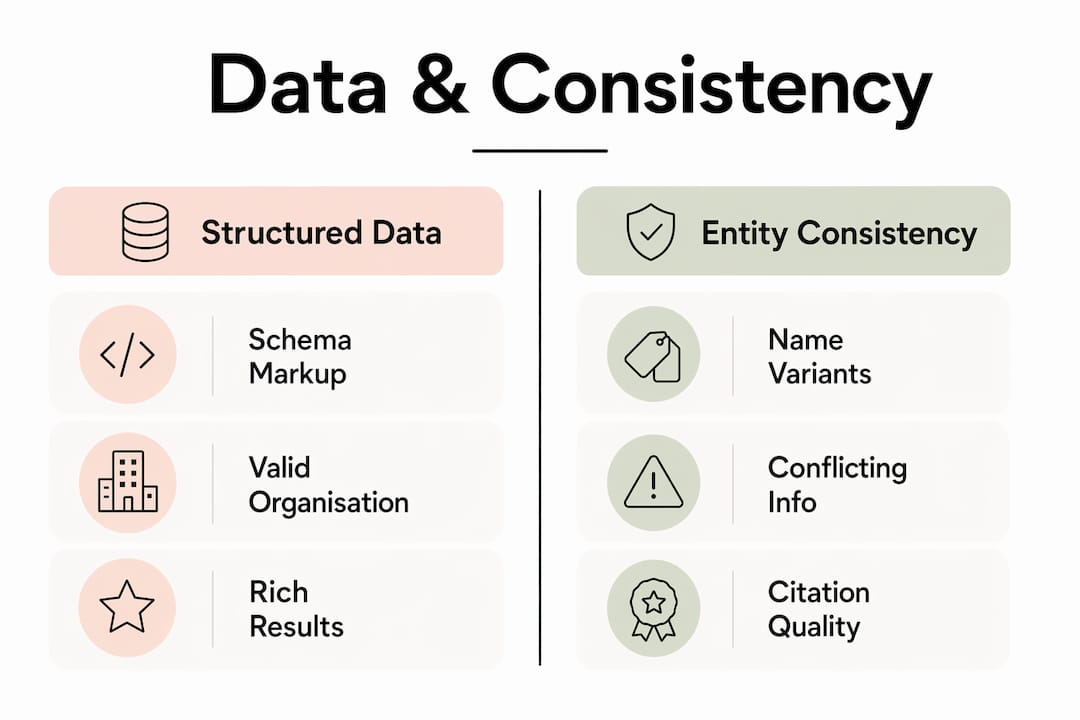
Conflicting data is more damaging than missing data. If your business name appears as three slightly different variants across your website, LinkedIn, and a trade directory, ChatGPT may treat them as separate entities or simply skip your brand to avoid the ambiguity.
Why Bing indexing is the single biggest technical factor
ChatGPT correlates 87% with Bing’s top results but only 56% with Google’s. That single statistic reframes the entire technical SEO priority for businesses targeting ChatGPT visibility. Ranking well on Google does not reliably translate into appearing in ChatGPT answers. Bing indexing does.
The practical steps to secure Bing indexing are straightforward:
- Verify your site in Bing Webmaster Tools and submit your XML sitemap.
- Check for crawl errors in the Bing Webmaster Tools dashboard and resolve any blocked pages.
- Review your robots.txt file to confirm you are not accidentally blocking Bingbot.
- Add an llms.txt file to your domain root. This emerging best practice signals to AI models which pages represent your authoritative content.
- Implement FAQ schema on key service pages, as Bing’s crawler prioritises structured, question-and-answer content for retrieval.
The table below summarises the key differences between optimising for Google and optimising for Bing in the context of ChatGPT visibility.
| Factor | Google SEO focus | Bing and ChatGPT focus |
|---|---|---|
| Search index correlation | 56% with ChatGPT | 87% with ChatGPT |
| Schema priority | Rich results and snippets | Organisation, FAQ, and Article schema |
| Crawler file | robots.txt | robots.txt plus llms.txt |
| Content format | Long-form and E-E-A-T signals | Answer-first, front-loaded structure |
| Verification tool | Google Search Console | Bing Webmaster Tools |
Businesses that have invested heavily in Google SEO often assume their Bing presence is equivalent. It rarely is. Bing Webmaster Tools frequently reveals unresolved crawl errors and unsubmitted sitemaps on sites that perform well in Google Search Console. Fixing those gaps is the fastest route to improving AI search visibility.
How to write content that ChatGPT will cite
Answer engine optimisation (AEO) is the recognised industry term for structuring content so that AI models can extract and cite it directly. AEO differs from traditional SEO in one critical way: the reader is not always a human. The primary audience for your opening paragraph is often an AI model deciding whether your page answers a query well enough to cite.
The evidence on content structure is specific. 44.2% of ChatGPT citations come from the first 30% of a webpage’s content. That finding comes from an analysis of 18,012 citations across 1.2 million responses. Front-loading your key claim is not a stylistic preference. It is the single most impactful structural change you can make to a page.
Content depth also drives citation frequency. Long-form content over 2,900 words averages 5.1 citations compared with 3.2 for pages under 800 words. Depth signals authority to both Bing’s crawler and ChatGPT’s retrieval layer.
Practical content principles for AEO include:
- Open every key page with a direct, one-sentence answer to the primary question the page addresses.
- Use hierarchical headings (H2 for main questions, H3 for sub-points) that mirror the phrasing of real buyer queries.
- Add FAQ schema to service pages, targeting the specific questions your customers ask before purchasing.
- Write separate pages for each service and each location you serve, rather than combining them on a single page.
- Avoid burying your business name, service description, or location in the middle of a paragraph.
Pro Tip: Check your service page content by reading only the first two sentences of each section. If those sentences do not contain your key claim, rewrite them so they do. ChatGPT’s retrieval layer often reads no further.
Being mentioned, cited, or recommended: what each means for your business
These three outcomes represent different levels of ChatGPT visibility, and they produce very different commercial results. Understanding the gap between them prevents wasted effort.
A brand mention means your business name appears in a ChatGPT answer. The model has enough entity confidence to name you, but not enough to link to your content. Mentions generate awareness but rarely drive direct traffic.
A URL citation means ChatGPT links to a specific page on your website as a source. This is a stronger signal. It means your content passed the model’s relevance and credibility threshold for that query. Citations do generate referral traffic, though volumes vary by query type.
A direct recommendation is the strongest outcome. ChatGPT names your business as the answer to a “who should I use?” query. This requires the highest level of entity confidence and external authority. Authoritative list mentions account for 41% of ChatGPT’s brand citation decisions, making third-party coverage the most important single factor in reaching recommendation status.
The citation-versus-mention gap is a real problem for businesses with strong brand awareness but thin owned content. You can appear frequently in AI answers without generating any traffic if your website lacks the depth and structure for ChatGPT to cite directly. Closing that gap requires both external authority building and on-site content investment.
Tracking your visibility across all three levels requires dedicated monitoring. Brand visibility tools typically show a 2–4 week lag between publishing new content and seeing it influence ChatGPT responses. Regular audits, run monthly at minimum, reveal which queries you appear in and which you are missing.
Key takeaways
Business visibility in ChatGPT is determined by entity recognition, Bing indexing, front-loaded content structure, and external authoritative mentions working together.
| Point | Details |
|---|---|
| No directory exists | Visibility is earned through entity signals and content credibility, not any listing process. |
| Bing indexing is critical | ChatGPT correlates 87% with Bing results, so Bing Webmaster Tools verification is non-negotiable. |
| Front-load your content | 44.2% of citations come from the first 30% of a page, so lead every page with your key claim. |
| Entity consistency prevents errors | Matching NAP data across LinkedIn, Crunchbase, and your website reduces hallucinations and omissions. |
| External mentions drive recommendations | Authoritative list mentions account for 41% of citation decisions, making third-party coverage the top priority. |
The shift I think most businesses are still missing
Most businesses I speak with are still treating ChatGPT visibility as a Google SEO problem with a new name. They focus on backlinks, domain authority, and keyword density, then wonder why they do not appear in AI answers. The issue is not their Google ranking. The issue is that they have never verified their site in Bing Webmaster Tools, their schema markup is absent or broken, and their service pages open with a paragraph about the company’s history rather than a direct answer to a buyer’s question.
The businesses that appear consistently in ChatGPT answers have usually done three unglamorous things well: they have kept their business name, address, and service descriptions identical across every platform they appear on; they have published detailed, answer-first content on Bing-indexed pages; and they have earned mentions in credible third-party lists and industry publications. None of those things require a large budget. They require consistency and patience.
The 2–4 week lag between publishing content and seeing it reflected in ChatGPT responses catches many businesses off guard. They make changes, see no immediate result, and assume the approach is not working. Monitoring tools that track brand visibility scores over time are the only reliable way to measure progress and stay motivated through that lag period.
My honest view is that AEO is not a replacement for traditional SEO. It is an additional layer that rewards businesses willing to think about their content from the perspective of a machine trying to synthesise a useful answer. The businesses that build that habit now will hold a significant advantage as AI search continues to grow. The trade business visibility checklist at gtwelve is a practical starting point for any service business working through these steps for the first time.
— Ben
How gtwelve can improve your ChatGPT visibility
gtwelve works with UK service businesses to build the technical and content foundations that AI models rely on for citations and recommendations.
That includes Bing Webmaster Tools setup, schema markup implementation, and content architecture aligned with answer engine optimisation principles. gtwelve audits your current entity signals across platforms, identifies gaps in your Bing indexing, and builds or restructures service pages to front-load the claims that ChatGPT’s retrieval layer prioritises. If your business is not appearing in AI answers for your core services, a visibility audit with gtwelve is the clearest way to find out why and fix it. Get in touch to arrange yours.
FAQ
Does listing my business on ChatGPT directly improve visibility?
There is no official ChatGPT business directory. Visibility is earned through consistent entity signals, Bing indexing, and credible content that AI models can retrieve and cite.
How long does it take to appear in ChatGPT answers?
New content typically takes 2–4 weeks to influence ChatGPT responses after Bing indexes it. Entity signal changes across third-party platforms can take longer to register.
Is Google SEO enough to appear in ChatGPT?
Google SEO alone is insufficient. ChatGPT correlates 87% with Bing’s top results but only 56% with Google’s, so Bing-specific optimisation is the more direct route to AI search visibility.
What is answer engine optimisation?
Answer engine optimisation (AEO) is the practice of structuring content so that AI models can extract, synthesise, and cite it directly in response to user queries. It prioritises front-loaded, machine-readable content over traditional keyword placement.
Why does ChatGPT sometimes give wrong information about my business?
Inaccurate information usually results from inconsistent NAP data across platforms. When your business name, address, or service description varies between your website, LinkedIn, and third-party directories, AI models may generate conflicting or fabricated details to fill the gaps.
Recommended
If this sounds like your website, we can take a look.
Note 13 of 72