Optimise your site for AI-powered search in 2026
6 July 2026 · 3 min read
Optimise your site for AI-powered search in 2026

AI-powered search optimisation is the practice of making your website’s content directly extractable and citable by AI systems such as ChatGPT, Perplexity, and Google’s AI Overviews. Unlike traditional SEO, which focuses on ranking positions, AI search visibility depends on whether an AI model selects your content as a trusted source when synthesising an answer. The shift matters for UK service businesses because AI search moves from ranking to citation, and businesses that fail to adapt will lose visibility to competitors who do. This guide covers the technical setup, content structure, and off-site signals you need to optimise site for AI-powered search in 2026.
What technical setup does your site need for AI search?
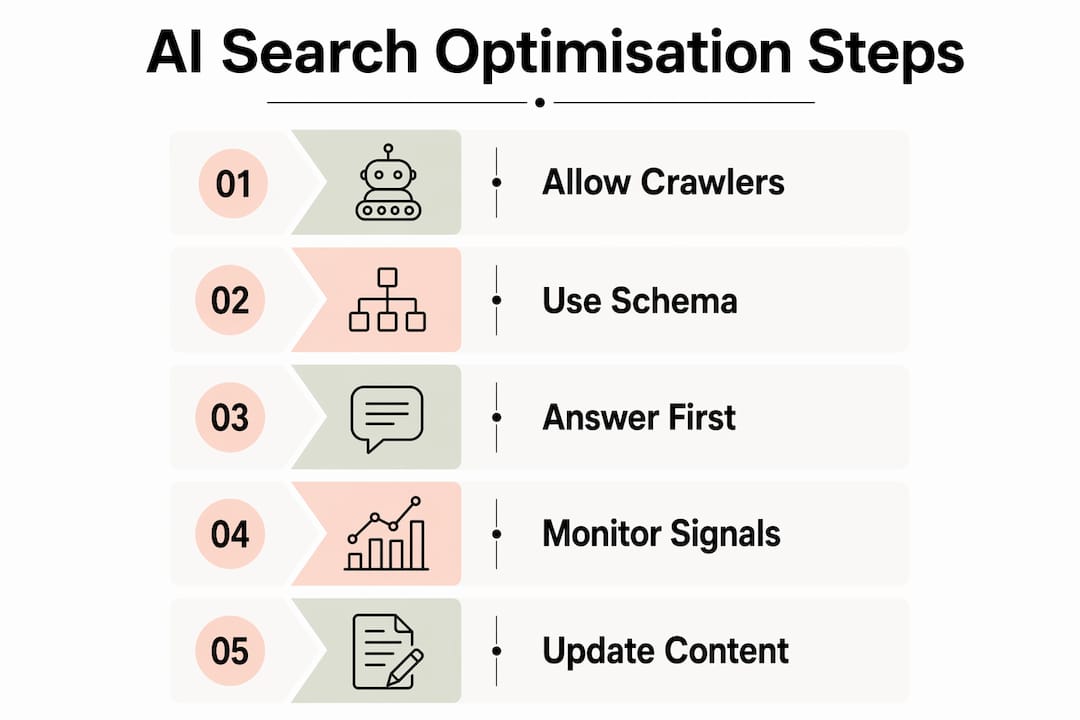
AI crawlers cannot cite what they cannot read. The first step to improve AI search ranking is confirming that AI-specific bots have permission to access your site.
Your robots.txt file controls which crawlers can index your pages. GPTBot, ClaudeBot, and PerplexityBot each have their own user-agent strings, and blocking any of them removes your content from that platform’s citation pool entirely. Check your robots.txt now and confirm none of these agents are disallowed.

Beyond permissions, a growing number of site owners publish an llms.txt file. This plain-text file sits at your root domain and tells AI systems which pages are authoritative and suitable for attribution. It does not replace robots.txt, but it adds a clear signal about content ownership and intent.
Technical performance also affects AI extraction. Page speed and Core Web Vitals determine how efficiently a crawler can process your pages. Slow load times increase the chance that a bot abandons a page before reading the key content. A clean XML sitemap and consistent canonical URLs prevent AI systems from encountering duplicate or conflicting versions of the same page.
- Allow GPTBot, ClaudeBot, and PerplexityBot in
robots.txt - Publish an
llms.txtfile at your root domain listing authoritative pages - Remove any
noindexmeta tags from pages you want cited - Submit an up-to-date XML sitemap via Google Search Console
- Pass Core Web Vitals benchmarks to support fast, complete page crawls
- Use canonical URLs to eliminate duplicate content signals
Pro Tip: Run your site through Google’s Rich Results Test and PageSpeed Insights before any content changes. Technical blockers undo every content improvement you make.
How should you structure content for AI citation?
AI crawlers score passages independently. A clear, self-contained answer at the start of each section is the single most effective formatting choice you can make. If your answer is buried under three paragraphs of context, the AI model will skip your page and cite a competitor who leads with the answer.
Burying answers reduces citation likelihood even when your page ranks well in traditional search. A page can sit in position two on Google and still receive zero AI citations because the answer appears too late. Write your key claim in the first 40–60 words of every section, then expand with evidence and examples.
Question-format H2 headings mirror the queries users type into AI search engines. Headings like “What causes damp in cavity walls?” or “How long does a boiler service take?” match the natural language patterns AI models use to retrieve relevant passages. Descriptive headings work for sub-sections, but your main H2s should read like real questions.
Schema markup supports but does not replace readable content. AI systems prioritise semantic clarity over schema alone, so well-written, direct prose outperforms a page that relies on JSON-LD without clear text. Apply schema where it fits naturally.
Recommended schema types by content format
| Content type | Schema.org type | When to apply |
|---|---|---|
| Service or product explainer | BlogPosting |
Standard articles and guides |
| Common questions section | FAQPage |
Pages with Q&A blocks |
| Step-by-step processes | HowTo |
Installation, repair, or setup guides |
| Business contact details | LocalBusiness |
Every page on a service business site |
- Open every section with a direct answer in 40–60 words.
- Use question-format H2 headings that mirror real user queries.
- Apply
FAQPageschema to any Q&A section on the page. - Apply
HowToschema to step-by-step service or process pages. - Keep paragraphs to 3–5 sentences with one idea per sentence.
- Avoid hook-style introductions that delay the core answer.
Pro Tip: Google advises focusing on expert, non-commodity content rather than fragmenting pages into tiny sections. One clear, authoritative answer beats five vague bullet points every time.
Why do off-site signals matter more than your own content?
Off-site citations account for 77% of AI brand citations, while owned content accounts for just 23%. That ratio is the most important number in AI search optimisation. It means your website alone cannot win AI visibility. What other platforms say about your business carries three times more weight.
Community platforms supply 46.7% of Perplexity AI’s top citations. Reddit threads, trade forums, and Q&A communities are not optional extras. They are primary citation sources for one of the fastest-growing AI search engines. A business that participates in relevant community discussions builds citation authority that no amount of on-site schema can replicate.
Off-site audit before on-site optimisation avoids hallucinated results and competitor substitutions in AI search outputs. If your business details are inconsistent across directories, review platforms, and social profiles, AI models will either hallucinate incorrect information or substitute a competitor whose data is cleaner and more consistent.
Practical off-site steps for service businesses:
- Audit your Google Business Profile, Yelp, Checkatrade, and Trustpilot listings for name, address, and phone number consistency
- Respond to reviews on every platform where your business appears
- Participate in relevant Reddit communities, trade forums, and local Facebook groups
- Seek editorial mentions in local news, trade publications, and industry directories
- Inconsistent business info risks hallucinated citations or competitor substitution, so treat data consistency as a monthly maintenance task
How does AI optimisation fit alongside traditional SEO?
AI optimisation is additive to traditional SEO, not a replacement. E-E-A-T criteria are functional inclusion requirements for AI models, meaning Experience, Expertise, Authoritativeness, and Trustworthiness are not just Google quality signals. They are the filters AI systems use to decide which sources to cite and which to ignore.
The table below shows where traditional SEO and AI optimisation overlap and where they diverge.
| Area | Traditional SEO focus | AI optimisation focus |
|---|---|---|
| Content format | Keyword density, headings | Answer-first paragraphs, question headings |
| Technical setup | Sitemaps, crawlability | robots.txt bot permissions, llms.txt |
| Authority signals | Backlinks, domain rating | E-E-A-T, off-site mentions, reviews |
| Visibility metric | Ranking position | Share of Voice in AI citations |
| Content depth | Comprehensive coverage | First-hand, non-commodity expertise |
Solid SEO fundamentals still matter. Clean URL structures, internal linking, and up-to-date sitemaps all support AI crawlability as well as traditional ranking. The URL structure for SEO principles that improve Google ranking also help AI bots navigate your site efficiently.
Fresh content is a consistent signal for both audiences. AI models favour sources that update regularly because stale information increases the risk of hallucinated or outdated citations. A content calendar that publishes new service pages, case studies, or guides every month keeps your site active in both traditional and AI search indices.
Pro Tip: AI search visibility depends on synthesis and citations rather than ranking position. A page that ranks fifth but answers a question clearly and directly will often receive more AI citations than the page ranked first.
What mistakes should you avoid when optimising for AI search?
The most common mistake is blocking AI crawlers in robots.txt without realising it. Many site owners or developers add blanket bot-blocking rules to reduce server load. Those rules often catch GPTBot and ClaudeBot as collateral damage, removing the site from AI citation pools entirely.
The second most common error is over-investing in schema markup before fixing content clarity. Schema markup is useful but only a hint. An AI model that encounters a page with perfect JSON-LD but vague, jargon-heavy prose will not cite it. Fix the prose first, then layer in schema.
Common pitfalls and their fixes:
- Blocking AI bots: Audit
robots.txtmonthly and explicitly allow GPTBot, ClaudeBot, and PerplexityBot. - Hook-style introductions: Rewrite section openings so the answer appears in the first two sentences.
- Neglecting off-site presence: Complete an off-site audit before any on-site changes. The 77% off-site citation ratio makes this the higher-priority task.
- Ignoring citation monitoring: Track your brand’s appearance in AI search outputs using manual queries and emerging AI analytics tools at least once a month.
- Inconsistent business data: A single mismatched phone number across directories is enough to trigger an AI hallucination or competitor substitution.
Monitoring matters as much as implementation. Experts recommend a 6-month playbook targeting 15–20 percentage point increases in AI Share of Voice. That timeline reflects how long it takes for off-site signals to accumulate and for AI models to update their citation patterns after you make changes.
Key takeaways
Businesses that combine technical access, answer-first content, and consistent off-site signals will secure the strongest AI citation rates in 2026.
| Point | Details |
|---|---|
| Allow AI crawlers | Explicitly permit GPTBot, ClaudeBot, and PerplexityBot in robots.txt to enter citation pools. |
| Lead with the answer | Write your key claim in the first 40–60 words of every section to maximise AI extraction. |
| Prioritise off-site signals | Off-site mentions account for 77% of AI citations, making directory and review consistency critical. |
| Apply E-E-A-T principles | AI models use Experience, Expertise, Authoritativeness, and Trustworthiness as inclusion filters, not just quality signals. |
| Monitor Share of Voice | Track AI citation performance monthly and expect meaningful gains over a 6-month improvement cycle. |
The off-site ratio changed how I think about this work
When I first started helping service businesses with AI search visibility, I focused almost entirely on the website. Better headings, faster pages, cleaner schema. The results were modest. Then I looked at the off-site citation data and realised the website was the smaller half of the problem.
The 77% off-site citation ratio was genuinely surprising to me. It means that a plumber with a mediocre website but strong Checkatrade reviews, active Reddit participation, and consistent Google Business Profile data will outperform a plumber with a technically perfect website and no off-site presence. That is a real shift in where the work needs to happen.
What I have found in practice is that most UK service businesses have the opposite problem. They invest in their website and ignore their off-site footprint entirely. Directories are outdated. Reviews go unanswered. No one has touched the Google Business Profile in two years. Fixing that backlog delivers faster citation gains than any on-site change.
The other thing I have learned is that patience is non-negotiable. AI models update their citation patterns slowly. You will not see results in two weeks. The 6-month improvement timeline is realistic, and businesses that expect instant results abandon the work before it compounds. The businesses that stay consistent are the ones that end up being cited.
— Ben
How gtwelve helps businesses get cited in AI search
gtwelve works with UK service businesses to build websites and content strategies that perform in both traditional and AI-driven search. If you are not sure whether your site is accessible to AI crawlers, or whether your content is structured to be cited rather than just ranked, a technical audit is the right starting point.
gtwelve’s AI and SEO visibility work covers crawler access audits, answer-first content restructuring, schema implementation, and off-site reputation management. The approach follows the same principles covered in this guide: fix technical access first, then content clarity, then off-site consistency. Businesses that want to generate better enquiries through AI search can get in touch with gtwelve to discuss where to start.
FAQ
What is AI-powered search optimisation?
AI-powered search optimisation is the process of making your website’s content accessible, structured, and authoritative enough for AI systems to select it as a citation source when answering user queries.
How do I allow AI crawlers to access my site?
Add explicit allow rules for GPTBot, ClaudeBot, and PerplexityBot in your robots.txt file. Check that no noindex meta tags are blocking pages you want cited.
Why does off-site content matter for AI search visibility?
Off-site signals such as reviews, directory listings, and community mentions account for 77% of AI brand citations. Your website alone cannot achieve strong AI visibility without a consistent off-site presence.
How long does it take to improve AI search citation rates?
Expect meaningful gains over a 6-month period. AI models update citation patterns gradually, and off-site signals take time to accumulate before they influence AI outputs.
Does schema markup guarantee AI citations?
Schema markup is a useful signal but not a guarantee. AI systems prioritise clear, answer-first prose over technical metadata, so readable content always comes before schema implementation.
Recommended
If this sounds like your website, we can take a look.
Note 18 of 72