What is a landing page for trades businesses?
4 July 2026 · 3 min read
What is a landing page for trades businesses?

A landing page is a standalone web page built for one purpose: to get a visitor to take a single, specific action, such as requesting a quote or booking a service. For tradespeople asking what is a landing page in trades marketing, the answer is simple. It is the focused destination you send someone to after they click your ad, Google listing, or social post. Unlike a homepage, it removes all distractions and points the visitor towards one outcome. Dedicated landing pages convert at 17.1% versus 7.9% for standard web pages. That gap is the difference between a phone that rings and one that stays silent.
What is a landing page and how does it differ from a homepage?
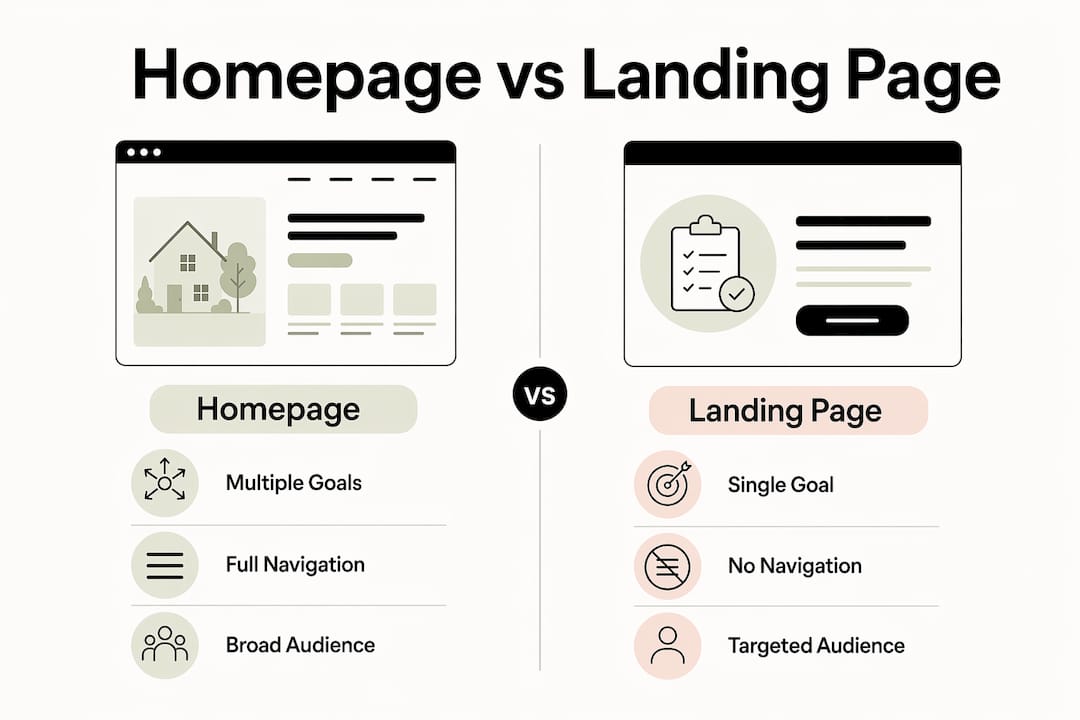
A homepage serves multiple audiences at once. It introduces your business, lists your services, links to your blog, and invites visitors to contact you, all at the same time. That breadth is useful for brand awareness but terrible for conversion. A landing page does the opposite.
The industry standard for landing pages is a 1:1 attention ratio: one goal, one action per page. Every element on the page exists to support that single outcome. There are no navigation menus pulling visitors away, no footer links to your gallery, and no “About Us” section diluting the message.

For a plumber running a Google Ads campaign for emergency boiler repairs, the homepage is the wrong destination. It shows bathroom fitting, drain unblocking, and general plumbing, which confuses the visitor. A dedicated landing page for emergency boiler repairs speaks directly to that one problem and asks for one thing: a call or a form submission.
| Feature | Homepage | Landing page |
|---|---|---|
| Navigation menu | Yes, full menu | No, removed entirely |
| Number of goals | Multiple | One |
| Audience | Broad, all visitors | Specific, from one campaign |
| Content focus | Brand overview | Single service or offer |
| Conversion purpose | General awareness | Direct lead or booking |
Removing navigation menus from landing pages is not optional. It is the single most important structural decision you make. Every link you leave on the page is a door the visitor can walk out of before converting.
You can see how this fits into a broader trade website structure by understanding which pages serve which purpose. The homepage builds trust. The landing page closes the lead.
What makes a good landing page for tradespeople?
A strong trades landing page has a clear headline that matches exactly what the visitor just clicked. This is called message match. If your Google Ad says “Emergency Electrician in Leeds,” your landing page headline must say the same thing. Mismatched headlines cause visitors to leave immediately, even if your service is exactly what they need.
The core elements of an effective trades landing page are:
- A single, specific headline that mirrors the ad or link the visitor came from
- One clear call to action such as “Request a free quote” or “Call now for same-day service”
- No navigation bar or footer links that could pull attention away
- Social proof including customer reviews, star ratings, and local testimonials
- Accreditation logos such as Gas Safe, NICEIC, or TrustMark, displayed prominently
- Your phone number and service area visible without scrolling
- A short contact form asking only for name, phone number, and job description
Social proof and accreditation logos reduce perceived risk for visitors. A homeowner looking for an electrician does not know you yet. Seeing your NICEIC badge and five recent Google reviews removes doubt faster than any amount of copy.
Pro Tip: Place your phone number at the very top of the page, above the fold. On mobile, make it a tap-to-call link. Most trades enquiries come from people who want to speak to someone, not fill in a form.
Decision fatigue is real. Every extra choice you give a visitor reduces the chance they convert. Keep the page focused on one service, one location, and one action. A landing page for a boiler service in Manchester should not also mention bathroom fitting in Sheffield.
What types of landing pages can tradespeople use?
Different marketing goals call for different page formats. Tradespeople have four main types to choose from, each suited to a specific stage of the customer’s decision.
-
Lead generation pages. These collect contact details through a short form. The visitor fills in their name, number, and job type, and you follow up. This works well for larger jobs such as full rewires or bathroom renovations where the customer needs a quote before committing.
-
Click-through pages. These warm up the visitor before sending them to a booking page. They explain the service, show proof, and build confidence. A gas engineer might use one to explain a boiler service package before the visitor reaches the booking calendar.
-
Squeeze pages. These collect email addresses in exchange for something useful, such as a free boiler maintenance checklist or a guide to planning a kitchen renovation. They build a list of warm prospects you can follow up with over time.
-
Direct booking or sales pages. These take the visitor straight to a booking form or payment. They work best for fixed-price services such as annual boiler services or EICR certificates where the price is clear and the decision is straightforward.
-
Thank you pages. These appear after a form is submitted or a booking is made. They confirm the action, set expectations, and can offer an upsell or ask for a referral.
| Page type | Best use for trades | Conversion goal |
|---|---|---|
| Lead generation | Large or custom jobs | Form submission |
| Click-through | Mid-consideration services | Warm-up before booking |
| Squeeze page | Email list building | Email address capture |
| Direct booking | Fixed-price services | Immediate booking |
| Thank you page | Post-conversion follow-up | Referral or upsell |
Most tradespeople start with a lead generation page. It is the most flexible format and works for almost any service type.
How do you create and optimise a landing page for your trade?
The first decision is where to host your landing page. Landing pages can sit on a subdomain such as quotes.yourbusiness.co.uk, or on a separate domain entirely. This lets you run focused campaigns for different services or locations without changing your main website. A roofing company might run separate pages for flat roof repairs, chimney work, and guttering, each targeting a different postcode area.
The practical steps to build an effective page are:
- Write a headline that matches your ad copy word for word
- Keep the form to three fields maximum: name, phone, and job description
- Add one strong image showing your work or your team on site
- Include two or three short testimonials with the customer’s first name and town
- Display your accreditation logos clearly, ideally near the call to action
- Remove the navigation bar and all footer links
- Test the page on mobile before launching, as most local search traffic is mobile
A/B testing is the most reliable way to improve a landing page over time. You run two versions of the page simultaneously, changing one element at a time, such as the headline or the call-to-action button colour. The version that converts more visitors wins. Over several months, this process compounds into a significantly better-performing page.
Many tradespeople include full website navigation on their landing pages by mistake. This is one of the most common and costly errors. Every link you leave on the page is a route away from your conversion goal.
Pro Tip: Track conversions from day one. Set up a thank-you page after your form and use it as a conversion goal in Google Analytics or Google Ads. Without tracking, you cannot tell which campaigns are generating real leads.
Landing pages should not function as digital brochures. A page that lists every service you offer, your company history, and your team photos is a homepage, not a landing page. Focus on one customer pain point and one solution. That focus is what drives conversion.
For a broader view of how landing pages fit into your overall web presence, the gtwelve guide on conversion-focused web design covers the design principles that make pages perform.
Key takeaways
A dedicated landing page outperforms a homepage for conversion because it removes distractions and focuses the visitor on one action.
| Point | Details |
|---|---|
| One goal per page | The 1:1 attention ratio means one action per page reduces decision fatigue and improves conversion. |
| Remove navigation | Deleting menus and footer links stops visitors leaving before they convert. |
| Message match matters | Your landing page headline must mirror the ad or link that brought the visitor to the page. |
| Trust signals convert | Gas Safe, NICEIC, and local reviews reduce perceived risk and increase form submissions. |
| Test and track | A/B testing and conversion tracking are the only reliable ways to improve performance over time. |
Why I think every tradesperson needs a dedicated landing page
Most tradespeople I speak to are sending paid traffic straight to their homepage. They are spending money on Google Ads and then pointing those clicks at a page with eight service links, a news section, and a contact form buried at the bottom. The leads that should be coming in are leaking out through every one of those exits.
The homepage is not the problem. It is the right tool for organic visitors who are browsing and learning. The problem is using it as a conversion page when it was never designed for that job. A landing page is built for one thing. When you match the ad, remove the distractions, and put a clear call to action in front of someone who already wants your service, the results are not subtle.
I have seen tradespeople double their enquiry rate simply by moving their ad traffic from a homepage to a focused page. No new ad spend. No redesign of the whole site. Just a single page built correctly. The improvement in conversion rate from that one change is often the biggest single gain a trade business can make online.
The other thing I would say is this: do not skip the trust signals. Gas Safe and NICEIC logos are not decoration. They are the fastest way to tell a stranger that you are qualified and accountable. Pair those with two or three genuine local reviews and you have removed the main reasons a visitor hesitates. Simple, focused, and trusted. That is what a good trades landing page looks like.
— Ben
How gtwelve builds landing pages for UK trades
gtwelve designs and builds conversion-focused landing pages specifically for UK tradespeople and local service providers. Every page is built around a single service and a single goal, with message match, trust signals, and mobile performance built in from the start.

If your current ads are sending traffic to your homepage, you are likely losing a significant share of potential leads. gtwelve connects your landing pages into a full enquiry system, including quote workflows, follow-up automation, and calendar booking, so no lead goes unanswered. Visit gtwelve.co.uk to see how we help trades businesses generate better enquiries and convert more of the traffic they are already paying for.
FAQ
What is a landing page in simple terms?
A landing page is a standalone web page with one goal: to get the visitor to take a specific action, such as calling you or submitting a quote request. It has no navigation menu and no distractions.
How is a landing page different from a homepage?
A homepage introduces your whole business to multiple audiences. A landing page targets one specific visitor with one specific offer and removes everything that does not support that single conversion goal.
Do tradespeople really need a landing page?
Yes. Tradespeople running paid ads who send traffic to their homepage lose leads to clutter and competing links. A dedicated landing page focuses the visitor and consistently produces higher conversion rates.
What should a trades landing page always include?
Every trades landing page needs a headline that matches the ad, a visible phone number, a short contact form, at least two customer reviews, and relevant accreditation logos such as Gas Safe or NICEIC.
How do I know if my landing page is working?
Set up a thank-you page after your form submission and track it as a conversion goal in Google Analytics or Google Ads. Without that tracking in place, you cannot measure which campaigns are generating real enquiries.
Recommended
If this sounds like your website, we can take a look.
Note 20 of 72