What is a service area page? A guide for businesses
2 July 2026 · 3 min read
What is a service area page? A guide for businesses

A service area page is a dedicated webpage that promotes a business’s services within a specific geographic area where it has no physical premises. Unlike a traditional location page tied to a shopfront or office address, a service area page targets towns, cities, or postcodes where the business actively works. Trades, mobile services, and local SMEs rely on these pages to rank in local searches and attract customers in areas they serve. Google’s Helpful Content guidelines reward pages that deliver genuine, locally relevant information rather than thin, template-filled text.
What is a service area page and how does it differ from a location page?
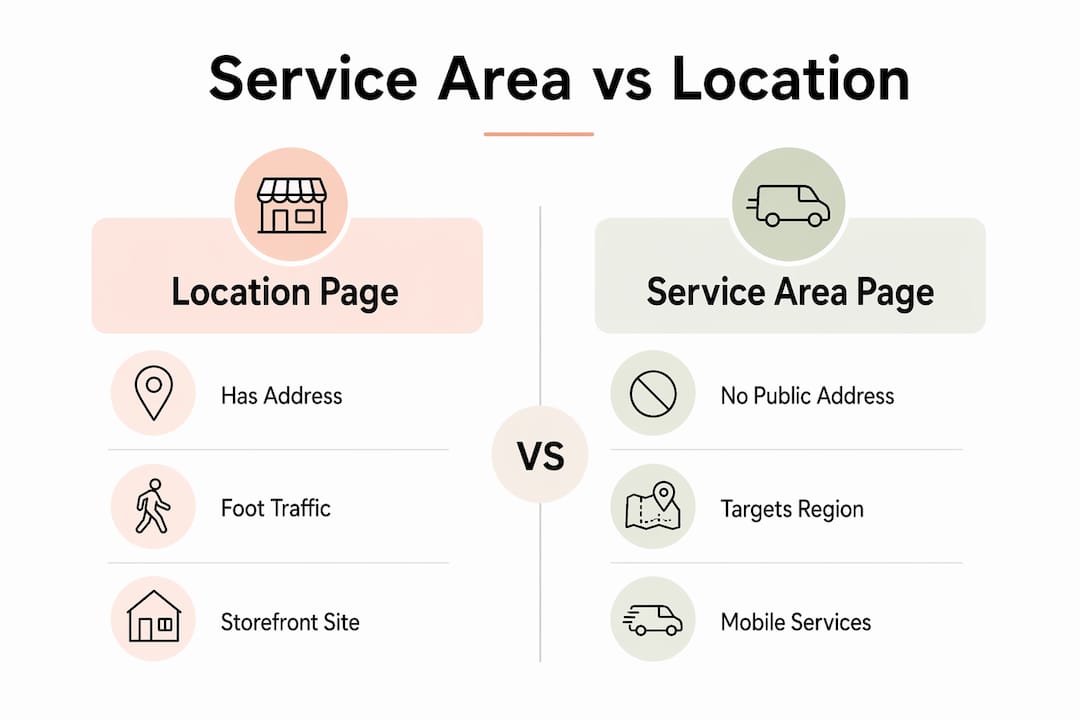
A service area page, often called a SAP in local SEO practice, is a location-targeted landing page built for businesses that travel to their customers rather than waiting for customers to visit them. A plumber covering five towns, a landscaper serving three counties, or a cleaning company working across a city all benefit from this page type. The standard industry term used by Google and SEO professionals is “service area page,” and it carries a specific technical meaning distinct from a location page.
A location page, by contrast, is built around a physical address with foot traffic. Think of a restaurant, a dental practice, or a retail shop. These pages feature opening hours, parking details, and directions because customers visit in person. A service area page has none of that. It focuses on the area served, the services offered there, and why local customers should choose that business.

The difference also shows up in Google Business Profile settings. Google Business Profile requires businesses using service area settings to hide their physical address. Displaying a home address or depot alongside service area claims creates conflicting signals that can harm local rankings.
| Point | Location page | Service area page |
|---|---|---|
| Has a public address | Yes | No |
| Targets foot traffic | Yes | No |
| Covers multiple towns | Rarely | Yes |
| Google Business Profile | Address visible | Address hidden |
| Best for | Shops, clinics, offices | Trades, mobile services, SMEs |
What should a service area page include?
An effective service area page contains several specific elements that separate a high-ranking page from a page that simply exists. Each element serves both the reader and the search engine.
- Custom H1 tag. The heading should name the service and the location together. “Boiler repair in Sheffield” is stronger than “Our services.” This signals relevance to Google and to the reader immediately.
- Unique, locally relevant content. Every page must contain information specific to that area. Mention local landmarks, common property types, or area-specific challenges. Avoid content duplication by tailoring each page with unique local references, projects, and customer testimonials.
- Schema markup. Adding
areaServedschema markup tells search engines exactly which geographic area the page covers. This technical signal improves how Google interprets and ranks the page. - Embedded local map. Embedding a Google Map of the specific service area provides visual confirmation to both customers and search engines about the targeted location.
- Localised reviews and testimonials. Customer reviews that mention the specific town or area carry more weight than generic five-star ratings. They build trust and add locally relevant text to the page.
- Clear call to action with contact details. Each page should have a phone number, contact form, or booking link that is easy to find. Unique contact information per page, where possible, strengthens local relevance.
- Optimised metadata. Title tags should be 55–70 characters and meta descriptions 150–160 characters. Staying within these limits prevents truncation in search results and keeps click-through rates strong.
Pro Tip: Adding a short video testimonial from a customer in that specific area can significantly lift conversion rates. Video testimonials on SAPs are an emerging trend in local SEO that increases engagement well beyond what text alone achieves.
How to create and optimise service area pages for multiple locations
Scaling service area pages across many locations requires a clear process. Without one, businesses end up with duplicate content, inconsistent quality, and pages that Google ignores.
- Plan a scalable page template. Build a consistent structure that covers the H1, introduction, services listed, testimonials, map, and call to action. The structure stays the same. The content within it changes for every location.
- Write unique content for each page. Generic text copied between pages triggers duplicate content issues. Mention a local project, a common issue in that area, or a specific neighbourhood. This is what separates a page Google ranks from one it filters out.
- Build a local link graph. A successful SAP links back to the core service page and horizontally to two or three sibling SAPs. This structure helps Google understand the full service territory and improves rankings across all pages in the group.
- Apply technical SEO correctly. Use canonical tags to avoid duplication signals, submit pages to Google Search Console, and check that each page is indexed. For businesses with many locations, a trade business visibility checklist helps confirm nothing is missed.
- Measure and refine performance. Track rankings, clicks, and enquiries per page using Google Search Console and Google Analytics. Pages that receive impressions but few clicks need stronger titles or meta descriptions. Pages with clicks but no conversions need better calls to action or more compelling content.
- Follow Google’s Helpful Content policy. Google prioritises content that serves users with genuinely helpful, locally relevant information over pages that merely aim to rank. Every SAP should answer a real customer question, not just repeat keywords.
Pro Tip: Include a short paragraph about a real local project or job completed in that area. Even one specific example, such as a loft conversion completed in a named street or a boiler replacement in a local housing estate, makes the page feel credible and locally genuine.
What are the benefits of service area pages for local SEO?
Service area pages deliver three core benefits: increased local SEO visibility, better customer engagement, and expanded geographic reach for businesses without physical premises. Each benefit compounds the others when pages are built correctly.
- Rank in local searches without a storefront. SAPs act as digital storefronts that enable ranking in local searches and connect businesses with customers in specific cities or neighbourhoods. A business based in one town can appear in search results across an entire region.
- Capture “near me” and location-specific searches. Customers searching for “electrician in Leeds” or “garden clearance near Harrogate” are ready to buy. A well-built SAP puts your business in front of those searches at exactly the right moment.
- Meet Google’s quality criteria. Service area pages serve as always-on customer service content that meets Google’s Helpful Content criteria when crafted well. Pages that answer real questions and provide genuine local detail rank better and stay ranked longer.
- Build credibility with local reviews. Localised testimonials signal to both Google and potential customers that the business has real experience in that area. This is particularly effective for trades and service businesses where trust is the primary buying factor.
- Improve conversion rates with targeted messaging. A page written specifically for customers in one area converts better than a generic services page. Tailored content, local references, and a clear call to action all contribute to more enquiries.
“A service area page is not just an SEO tactic. It is a customer-facing document that tells a local audience exactly what you do, where you do it, and why you are the right choice.”
Supporting your SAP strategy with a well-structured website is covered in the trade website must-have pages guide, which outlines the full set of pages a service business needs to generate consistent enquiries.
Key takeaways
Service area pages are the most direct way for service businesses to rank in local searches across multiple locations without a physical presence in each one.
| Point | Details |
|---|---|
| Core definition | A SAP targets a geographic area where a business works but has no physical premises. |
| Key difference from location pages | Location pages need a public address; SAPs hide the address and focus on areas served. |
| Must-have content | Custom H1, unique local content, schema markup, embedded map, and localised reviews. |
| Linking strategy | Link each SAP to the core service page and two to three sibling SAPs to build a local link graph. |
| Primary benefit | Rank in local searches, capture buying-intent queries, and convert local customers without a storefront. |
Why most service area pages fail before they even rank
The businesses I see struggle most with SAPs are not the ones who skip them entirely. They are the ones who build twenty pages in a weekend using the same paragraph with the town name swapped out. Google’s systems are sophisticated enough to recognise that pattern, and those pages simply do not rank.
The pages that perform well share one quality: they feel like they were written by someone who has actually worked in that area. A roofing company that mentions the prevalence of Victorian terraces in a specific postcode, or a garden designer who references the clay soil conditions common to a particular county, signals genuine local knowledge. That specificity is what Google’s Helpful Content guidance is pushing businesses towards, and it is also what converts a visitor into an enquiry.
The linking structure matters more than most businesses realise. I have seen SAP sets where every page is an island, with no internal links connecting them. Building a local link graph, where each SAP connects to the main service page and to two or three neighbouring SAPs, gives Google a map of your territory. Without it, each page fights alone.
The multimedia trend is worth taking seriously too. Short video testimonials from customers in specific areas are still rare enough to stand out. They add credibility, increase time on page, and give Google a richer signal about content quality. For trades and local services, a thirty-second clip from a satisfied customer in the right postcode is worth more than three paragraphs of keyword-rich text.
— Ben
How gtwelve builds service area pages that generate real enquiries
gtwelve works with UK trades, local service providers, and SMEs to plan, build, and optimise service area pages as part of a complete local SEO system.

Every SAP gtwelve produces includes unique local content, correct schema markup, optimised metadata, and a linking structure that builds authority across your full service territory. The work connects directly into your enquiry workflows, so leads from those pages reach you without manual effort. If you want to generate better enquiries from the areas you already serve, visit gtwelve.co.uk to see how the full system works and what it could do for your business.
FAQ
What is a service area page in simple terms?
A service area page is a webpage that promotes your services in a specific town or area where you work but do not have a physical office or shop. It helps your business appear in local search results for that location.
How many service area pages does a business need?
A business should create one service area page for each distinct town, city, or region it actively serves. Each page must contain unique content to avoid duplicate content issues and rank effectively.
Do service area pages work without a Google Business Profile?
Service area pages on your website can rank in organic search without a Google Business Profile. However, combining SAPs with a correctly configured Google Business Profile, with your address hidden and service areas listed, produces the strongest local SEO results.
What is the difference between a service area page and a location page?
A location page is built around a physical address where customers visit in person. A service area page targets an area the business serves remotely, with no public address displayed, and is designed for businesses that travel to their customers.
How long should a service area page be?
A service area page should be long enough to cover the service offered, local context, customer testimonials, and a clear call to action. In practice, pages of 400–800 words with supporting media tend to perform well, provided the content is genuinely useful and locally specific.
Recommended
If this sounds like your website, we can take a look.
Note 22 of 72