What is an AI search engine? A 2026 guide
28 May 2026 · 3 min read
What is an AI search engine? A 2026 guide

AI search engines are no longer a niche experiment. They are reshaping how billions of people find information every day, and understanding what an AI search engine is has gone from a curiosity to a genuine business necessity. Google AI Overviews appeared in roughly 16% of all searches by late 2025, and that figure has grown substantially since. For individuals wondering where the web is heading, and for businesses trying to stay visible, this guide explains exactly what these systems are, how they work, and what they mean for you.
Table of Contents
- Key takeaways
- What is an AI search engine?
- How AI search engines work
- Benefits and challenges for users and businesses
- Comparing popular AI search engines
- Preparing your content for AI search visibility
- My take on AI search engines
- How gtwelve helps businesses with AI search
- FAQ
Key takeaways
| Point | Details |
|---|---|
| AI search is not keyword matching | AI search engines understand meaning and context, not just the words you type. |
| Direct answers replace link lists | Users increasingly get a single synthesised answer rather than ten blue links to click through. |
| Visibility works differently now | Brands are either cited in AI answers or absent entirely. There is no page two. |
| Content structure matters more than ever | Well-structured, recent, and clearly attributed content earns more citations in AI responses. |
| Tracking requires new tools | Standard SEO tools cannot reliably measure AI search visibility across multiple platforms. |
What is an AI search engine?
A traditional search engine matches your query to a list of web pages ranked by relevance and authority. You type a phrase, you get ten links, and you decide which one to click. An AI search engine does something fundamentally different. It understands your question, reasons about it, and writes you an answer, usually in plain language, often without requiring you to click anywhere.
The core technology behind these systems is the large language model (LLM). These are trained on enormous volumes of text and learn to predict and generate language in ways that simulate understanding. When you ask an AI search engine a question, it does not retrieve a list of documents. It synthesises information from multiple sources into a single, conversational response.
Here are the most widely used AI search engines available today:
- Google AI Mode and AI Overviews — Google’s integration of generative AI directly into its search results, now serving over a billion users monthly.
- ChatGPT Search — OpenAI’s conversational search product, which draws on live web data and its language model to answer queries directly.
- Perplexity — A dedicated AI search engine that cites its sources clearly and allows follow-up questions in a threaded conversation.
- Google Gemini — Google’s multimodal AI assistant, capable of handling text, images, and documents as part of a search query.
- Microsoft Copilot — Microsoft’s AI search integration built into Bing and across the Microsoft 365 suite.
What distinguishes all of these from traditional search is the shift from retrieval to synthesis. Rather than pointing you toward an answer, AI search engines attempt to give you the answer directly. That shift has significant consequences for users and businesses alike.
How AI search engines work
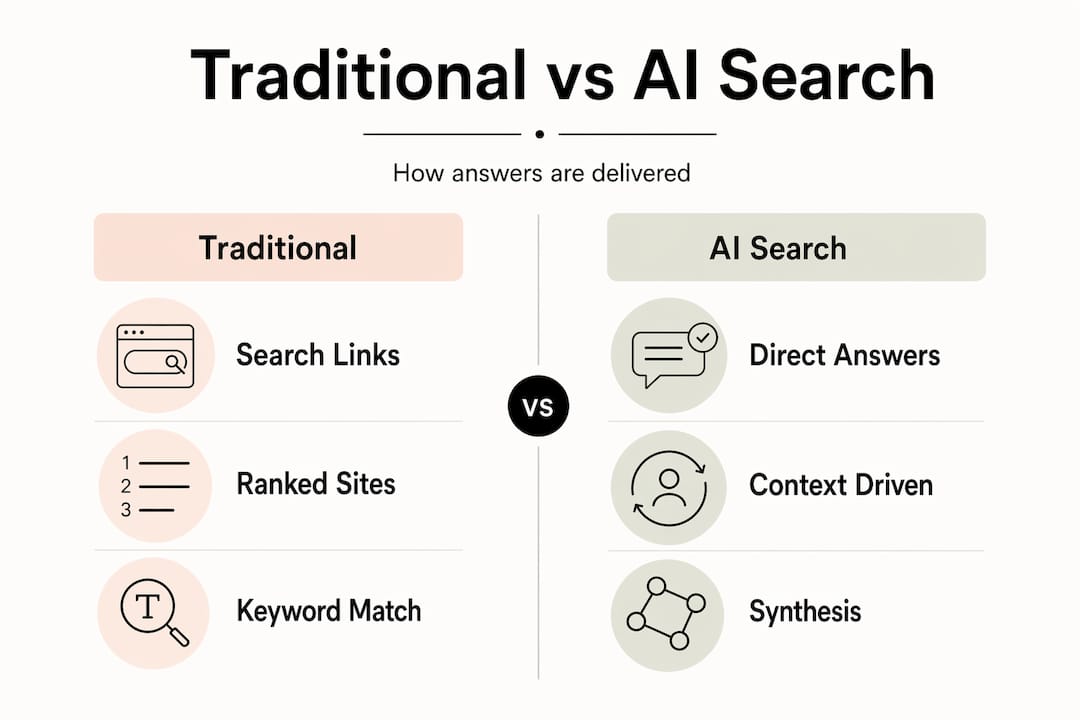
Understanding the technology helps you make sense of why AI search engines behave the way they do. The process is more involved than a standard keyword lookup.
When you submit a query, the AI search engine first parses the language to understand your intent. It is not looking for an exact phrase match. It is interpreting context, implied meaning, and the likely purpose behind your question. This is called natural language understanding, and it is one of the foundational capabilities of large language models.
From there, the system retrieves relevant content from its knowledge base or from live web sources, depending on the platform. It then reasons across those sources to identify consistent, reliable information. Finally, it generates a response in natural language, often with citations or follow-up suggestions built in.
Google’s Gemini 3.5 Flash introduced multimodal inputs to this process, meaning you can now submit a query using text, images, videos, files, or even a browser tab as context. That kind of input flexibility changes what “searching” actually means.
Pro Tip: If you want to understand how an AI search engine interprets your content, try asking it a question your business commonly receives. The answer it gives, and what it cites, tells you a great deal about how your content is being read by these systems.
The quality of the response depends heavily on the training data, the recency of indexed content, and how clearly that content is structured. AI search engines do not rank pages. They decide whether to quote, paraphrase, or ignore a given source entirely. That is a significant shift from the traditional search model, and it is why AI visibility differs fundamentally from ranking on page one of Google.
Benefits and challenges for users and businesses
For everyday users, AI search engines deliver real advantages. Conversational queries get direct answers. Follow-up questions feel natural. You can ask complex, multi-part questions in plain English and receive a structured response rather than a set of disconnected links.

For businesses, the picture is more complicated. The benefits are real, but so are the challenges.
Clicks on traditional organic results drop by roughly 50% when an AI overview is present in the results. Users who get their answer from the AI summary have no reason to visit your site. That means traffic figures alone no longer tell the full story of your online visibility.
At the same time, being cited in an AI answer is arguably more valuable than a traditional ranking. AI is increasingly the first point of contact between customers and brands. If an AI search engine recommends your business in response to a relevant query, the credibility attached to that recommendation is significant. It carries the weight of the AI’s apparent authority.
The practical implications for businesses include:
- Reduced click-through from organic results, as users get answers without visiting your site.
- New citation opportunities, where your content is quoted or referenced in AI-generated answers.
- A binary visibility model — you are either present in the AI’s response or you are not. There is no equivalent of ranking in position four or seven.
- Greater emphasis on content quality over domain authority. Small and medium brands can compete if their content is well-structured and specific.
Understanding what AI search visibility means for your business is no longer optional. It is where discoverability is being decided.
Comparing popular AI search engines
Not all AI search engines are built for the same purpose. The table below outlines the key differences across the main platforms.
| Platform | Strengths | Best for | Key limitations |
|---|---|---|---|
| Google AI Mode | Real-time web data, multimodal inputs, scale | General queries, local search, news | Can suppress organic clicks significantly |
| ChatGPT Search | Conversational depth, coding, analysis | Complex research, writing tasks | Accuracy varies; occasional hallucinations |
| Perplexity | Clear source citations, follow-up threading | Research, fact-checking | Smaller index than Google |
| Google Gemini | Multimodal capability, Google ecosystem | Visual queries, document analysis | Still maturing for general web search |
| Microsoft Copilot | Microsoft 365 integration, enterprise use | Workplace tasks, productivity | Less natural for consumer search |
Each platform uses different citation logic and source preferences, which is why tracking across multiple AI models simultaneously is necessary for an accurate picture of your visibility. What ranks well in one AI engine may not appear in another at all.
For businesses considering how AI adoption fits into their operations, AI tools for small business growth cover a broader set of use cases beyond search, including customer service and workflow automation.
Preparing your content for AI search visibility
Optimising for AI search visibility is not the same as traditional SEO. You are not trying to rank higher on a results page. You are trying to be the source an AI engine trusts enough to quote.
Here is a practical sequence to follow:
- Structure content clearly. Use descriptive headings, concise paragraphs, and direct answers to specific questions. AI search engines favour well-structured content distributed under clear headings rather than long, unbroken prose.
- Prioritise freshness. Recent content earns 20% more citations in AI responses. Update existing pages regularly, not just when publishing new content.
- Add explicit author attribution. Including clear author names and credentials signals credibility. Explicit author attribution is a critical signal for AI engines assessing whether to recommend your content.
- Include statistics and citations. Content with data, referenced sources, and recent figures earns 30 to 40% higher visibility in AI responses. Back your claims.
- Track your AI citation presence. Standard SEO tools cannot reliably measure this. A custom AI visibility tracker using platform APIs costs around £60 to £80 per month and covers ChatGPT, Claude, Gemini, and Google AI Mode.
Pro Tip: Run your key service or product questions through three or four different AI search engines each month. Note which competitors get cited and what those pages have in common. That pattern tells you exactly what to fix.
The businesses that adapt to these signals now will have a meaningful advantage as AI search continues to grow. Those that wait and rely solely on traditional rankings are likely to see organic visibility decline without understanding why.
My take on AI search engines
I’ve worked with service businesses on their online visibility for long enough to see patterns clearly, and the shift happening right now is the most significant one I’ve observed in years.
What I find most businesses get wrong is treating AI search as a future concern. It is a present one. When a potential customer asks an AI assistant for a local service recommendation and your business is not cited, you have lost that enquiry before you even knew it existed. That is already happening.
The other misconception I see regularly is that AI search replaces traditional SEO. It does not. The two work differently but they are not in competition. Your Google rankings still matter. What is changing is that they are no longer sufficient on their own. You need presence across both surfaces.
What I have learned from building visibility strategies across multiple platforms is that the fundamentals are not mysterious. Clear content, genuine expertise, recent updates, and proper structure. None of that is new advice. What is new is that AI engines weight these signals very differently from Google’s traditional algorithm, and measuring that impact requires different tools and different thinking.
The businesses I see thriving in AI search are not the ones with the biggest budgets. They are the ones with the most specific, trustworthy content on their subject. That is genuinely levelling for smaller businesses, if they recognise it early enough.
— Ben
How gtwelve helps businesses with AI search
If this article has clarified what AI search engines are and why visibility within them matters, the next practical question is what to do about it for your business.
gtwelve works with UK service businesses to build online presence that performs across both traditional search and AI-driven discovery. That includes structured content built for AI citation, technical SEO, service and location page planning, and reporting systems that track where your business is actually being found. If you are ready to adapt your digital presence to how search works in 2026, explore what gtwelve offers and get in touch to discuss your situation directly.
FAQ
What is an AI search engine, simply explained?
An AI search engine uses large language models to understand your question and generate a direct, synthesised answer rather than returning a list of web page links.
How does an AI search engine differ from Google?
Traditional Google search returns ranked links for you to browse. AI search engines like Google AI Mode or Perplexity read those sources and write a response for you, often without requiring a click.
What are the main benefits of AI search engines?
They deliver faster, more conversational answers to complex questions, reduce the time spent clicking through multiple pages, and can handle multimodal inputs such as images and documents.
What is AI search visibility and why does it matter?
AI search visibility refers to how often your brand or content is cited in AI-generated answers. Unlike traditional rankings, you are either included or excluded, making it a critical metric for discoverability.
How can a business improve its AI search visibility?
Focus on clear content structure, regular updates, explicit author attribution, and data-backed claims. Content with statistics and citations earns significantly higher visibility in AI responses than general or unattributed writing.
Recommended
If this sounds like your website, we can take a look.
Note 57 of 72