What is social proof websites: a 2026 guide
25 June 2026 · 3 min read
What is social proof websites: a 2026 guide

Social proof websites are platforms that use evidence from existing customers, trusted sources, and peer behaviour to build credibility and increase conversions. The term comes from Robert Cialdini’s principle of social proof, which holds that people look to the actions of others when uncertain about a decision. In marketing, this translates directly into testimonials, star ratings, case studies, trust badges, and real-time activity notifications placed strategically across a website. Business owners and marketers who understand what social proof websites do gain a measurable advantage in closing the gap between a visitor’s first impression and a confirmed enquiry or purchase.
What types of social proof are most effective on websites?
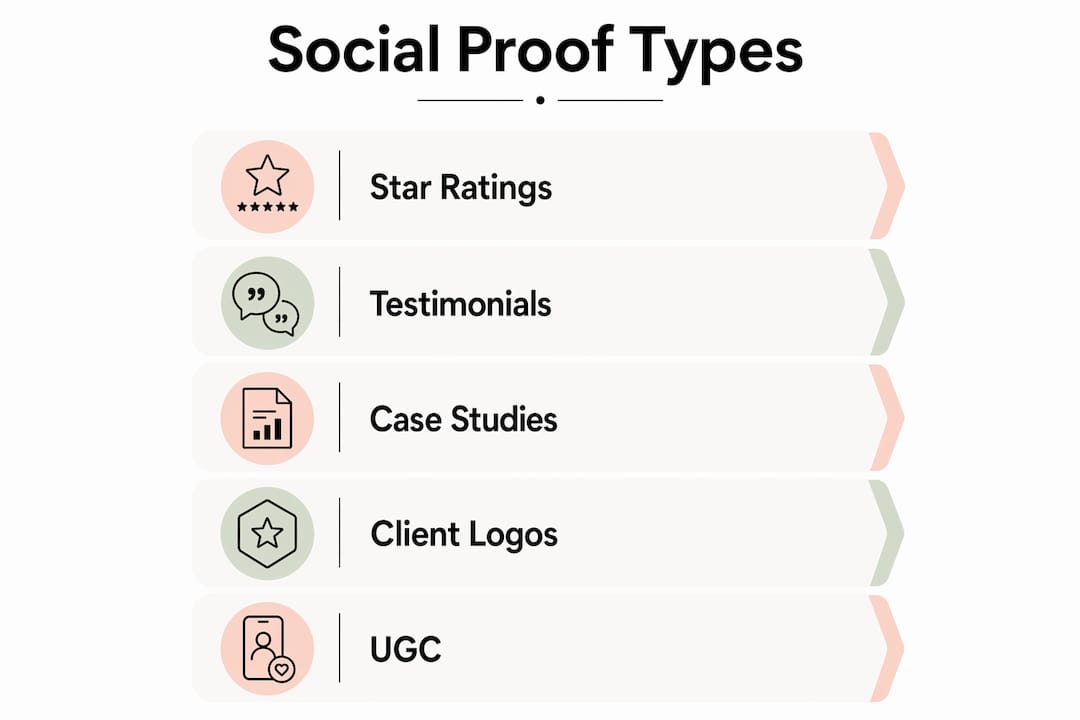
Social proof in marketing covers several distinct formats, and each one serves a different purpose in the buying journey.
Customer reviews and star ratings are the most widely recognised form. Testimonials with photos are significantly more memorable than those without, according to CXL eye-tracking research (p=0.0035). Adding a real name and face turns an abstract claim into a credible human account.

Case studies with specific results matter most in B2B contexts. A case study citing a 22% reduction in churn outperforms a vague quote like “great service” every time. Buyers in professional services and SaaS want proof that is tied to outcomes they can relate to.
Client logos and certifications carry weight only when given context. Generic logos without context are routinely ignored by website visitors. Pairing a logo with a line such as “Trusted by 5,000+ businesses” transforms a passive badge into a credible signal.
Real-time activity notifications show live or recent user behaviour, such as “Sarah from Leeds just booked a consultation.” BDOW recommends triggering updates every 5–10 seconds with page-specific information to avoid looking artificial.
User-generated content (UGC) refers to photos, videos, or posts created by customers rather than the business itself. UGC is a form of social proof that carries high authenticity because it is unprompted and unscripted.
The most effective approach is to stack multiple proof types rather than rely on one format. Stacking multiple proof types across different site pages consistently outperforms single-format approaches.
| Proof type | Best used for |
|---|---|
| Star ratings with photos | Ecommerce and local services |
| Metric-driven case studies | B2B and professional services |
| Client logos with context | Enterprise and SaaS landing pages |
| Real-time notifications | High-traffic product and booking pages |
| User-generated content | Consumer brands and lifestyle services |
Pro Tip: Ask customers two or three specific questions when requesting a testimonial. Salesforce notes that guiding customers with focused questions avoids the blank-page problem and produces far more useful, specific responses.
Why does social proof influence customer behaviour on websites?
Social proof works because it reduces uncertainty. When a visitor lands on your website without prior knowledge of your business, they face a trust gap. They cannot verify your claims directly, so they look for signals that others have already made the same decision and found it worthwhile.
Robert Cialdini identified social proof as one of six core principles of influence. The effect is strongest when the person is uncertain and when the social proof comes from someone they perceive as similar to themselves. A sole trader reading a testimonial from another sole trader is more influenced than one reading a quote from a large corporation.
“Social proof isn’t manipulation. It’s human nature to trust the actions of similar others when uncertain.” — BDOW
The numbers support this. Over 92% of consumers hesitate to buy products that have no reviews at all. That figure shows how deeply the absence of social proof damages purchase confidence, even before a visitor has read a single word of your copy.
Products with at least five reviews sell 270% better than those with none. The leap from zero to five reviews is the single most impactful improvement a new product page can make.
Social proof also activates what psychologists call the consensus principle. When people see that a large group has made a particular choice, they interpret that consensus as evidence of quality. This is why phrases like “Join 10,000 satisfied customers” work. They signal that the crowd has already done the evaluation work on the visitor’s behalf.
How to strategically implement social proof on your website
Effective implementation starts with mapping proof types to specific buyer objections rather than scattering testimonials randomly. Treating social proof as a modular system targeted by page context and buyer stage produces far better results than placing a single testimonials section on your homepage and leaving it there.
A practical framework for placement looks like this:
- Homepage: Use client logos with quantitative context and one or two short, outcome-focused testimonials near the hero section to establish credibility immediately.
- Service or product pages: Place case studies and detailed reviews directly beside the call to action. Visitors reading a service page are evaluating a specific decision, so proof must address that specific concern.
- Checkout or enquiry form: Add trust badges, security certifications, and a brief testimonial immediately above the submit button. This is where hesitation peaks, and proof near calls to action directly reduces abandonment.
- About page: Feature team credentials, industry accreditations, and press mentions. Visitors here are assessing whether they trust the people behind the business.
- Blog and content pages: Include a short proof strip or a relevant case study snippet to reinforce credibility even in educational content.
Many businesses overlook proof that already exists in their communications. Positive feedback in DMs or support emails can be converted into formal testimonials with the customer’s permission. This is one of the fastest ways to build a proof library without starting from scratch.
Avoid common mistakes that undermine credibility. Static testimonials that have not been updated in years signal neglect. Vague quotes without names, roles, or outcomes read as fabricated. Overusing real-time notifications on every page creates a carnival atmosphere that erodes trust rather than building it.
Pro Tip: Tailor your proof type to your industry. Trades and local services benefit most from Google Reviews and before-and-after photos. Professional services firms convert better with named case studies and accreditation logos. Ecommerce sites see the strongest lift from star ratings and UGC photos. A conversion-focused web design approach treats proof placement as a design decision, not an afterthought.
What are the benefits and pitfalls of social proof on websites?
The benefits of social proof are direct and measurable. Credibility increases because visitors see that real people have already trusted the business. Hesitancy drops because the uncertainty that blocks decisions is replaced by evidence. Conversion rates improve because proof addresses objections before a visitor has to voice them. Customer loyalty strengthens because buyers who chose based on peer evidence feel validated in their decision.
The pitfalls are equally real and often self-inflicted:
- Generic testimonials such as “Great company, would recommend” add almost no value. They lack specificity, context, and credibility.
- Uncontextualised logos placed on a page without any supporting detail are ignored. Visitors cannot evaluate a logo without knowing what it represents or how many customers it reflects.
- Artificial or spammy notifications that show fabricated activity destroy trust the moment a visitor recognises the pattern.
- Outdated proof signals that the business is no longer active or no longer collecting feedback, which raises doubts about current quality.
- Overloading a page with proof elements creates visual noise and dilutes the impact of each individual signal.
The importance of social proof lies not just in having it, but in keeping it current and specific. Strategically mapping proof types to buyer stages and objections is what separates businesses that see conversion lifts from those that add a testimonials section and wonder why nothing changed.
Pro Tip: Review your testimonials every quarter. Replace any that are older than 18 months or that lack a specific outcome. Fresh, specific proof consistently outperforms a large volume of vague, dated quotes.
Key takeaways
Social proof websites convert more visitors because they replace uncertainty with evidence from real customers, and the most effective implementations treat proof as a dynamic system mapped to specific buyer objections and page contexts.
| Point | Details |
|---|---|
| Photos and names matter | CXL research confirms testimonials with photos are significantly more memorable than those without. |
| Specificity beats volume | A case study citing a 22% result outperforms ten generic quotes in B2B contexts. |
| Placement is critical | Proof placed near calls to action and checkout reduces hesitancy at the exact moment it peaks. |
| Hidden proof is underused | Positive feedback in emails and DMs can become formal testimonials with the customer’s permission. |
| Stack multiple formats | Combining reviews, logos, case studies, and UGC across pages outperforms any single proof type. |
Social proof in 2026: what I’ve learned from working with service businesses
Most businesses treat social proof as a one-time task. They collect a handful of testimonials when they launch, add them to a page, and never revisit them. That approach was adequate five years ago. It is not adequate now.
What I see consistently with service businesses is that their best proof is buried. It is sitting in a reply to a Google review, in a WhatsApp message from a satisfied client, or in a follow-up email that nobody thought to save. The businesses that win on trust are the ones that build a system for capturing that proof continuously, not just when they remember to ask.
The shift I find most significant right now is the move toward outcome-specific proof. Visitors in 2026 are more sceptical than ever. A quote that says “fantastic service” does nothing. A quote that says “we reduced our admin time by three hours a week after switching” does a great deal. That specificity is what builds trust online in a way that generic praise simply cannot.
I also think the integration of social proof with overall website design is underestimated. Proof dropped into a page as an afterthought looks like an afterthought. When it is designed into the page structure, positioned at the right moments in the buyer journey, and updated regularly, it becomes part of how the business communicates quality. That is a fundamentally different thing.
The businesses I work with that take this seriously see real differences in enquiry quality, not just volume. Visitors arrive already convinced, because the website did the convincing work before the conversation started.
— Ben
How gtwelve builds websites that put social proof to work
A well-designed website does not just display testimonials. It places the right proof in front of the right visitor at the right moment in their decision.
gtwelve builds conversion-focused websites for UK service businesses, trades, and SMEs, with social proof built into the page structure from the start. That means reviews near enquiry forms, case studies on service pages, and trust signals that are designed to be seen rather than scrolled past. If your current website is not actively using the credibility you have already earned, see how gtwelve can help you put it to work. Whether you are starting from scratch or redesigning an existing site, the approach is the same: proof that is specific, current, and placed where it converts.
FAQ
What is social proof on a website?
Social proof on a website is any content that shows prospective customers that others have already trusted and benefited from a business. Common formats include customer reviews, star ratings, case studies, client logos, and trust badges.
Why is social proof important for conversions?
Over 92% of consumers hesitate to buy without reviews, which shows that the absence of social proof directly blocks purchase decisions. Adding specific, credible proof reduces that hesitancy and increases the likelihood of an enquiry or sale.
What are the most effective types of social proof?
Customer reviews with photos and real names, metric-driven case studies, and contextualised client logos are consistently the most effective. The strongest results come from combining multiple proof types across different pages rather than relying on one format.
How do I collect better testimonials?
Ask customers two or three specific questions rather than requesting an open-ended review. Salesforce recommends this approach to avoid vague responses and gather proof that addresses real buyer concerns.
Where should social proof be placed on a website?
Place proof near calls to action, on product and service pages, and directly above enquiry forms or checkout buttons. These are the points where visitor hesitancy is highest and where credible evidence has the greatest impact on conversion.
Recommended
If this sounds like your website, we can take a look.
Note 29 of 72