What is website lead generation? A clear guide
1 June 2026 · 3 min read
What is website lead generation? A clear guide

Website lead generation is the process of designing your site to actively capture visitor information and convert anonymous traffic into contacts your sales team can engage with. Unlike a standard brochure site that simply displays information, a lead generation website uses forms, calls-to-action, gated content, and multiple conversion points to collect names, email addresses, and enquiry details. The industry term for this practice is inbound lead generation, and it sits at the heart of any serious digital marketing strategy. Whether you run a trades business, a local service firm, or a growing SME, understanding how this works is the difference between a website that costs money and one that makes it.
What is website lead generation and why does it matter?
Lead generation is the strategic process of attracting, capturing, and nurturing prospects who demonstrate buying intent until they are ready to purchase. For websites specifically, this means every page, button, and form is designed with one goal: turning visitors into contacts. A visitor who lands on your site and leaves without taking action is a lost opportunity. A visitor who fills in a quote form, downloads a checklist, or books a call is now a lead you can follow up.
The importance of lead generation cannot be overstated for service businesses. Paid advertising, SEO, and social media all drive traffic, but traffic alone does not pay invoices. Your website must convert that traffic into enquiries. Treating the entire website as a lead capture machine, with intentional conversion opportunities across multiple pages, consistently increases both lead volume and quality. A single contact page buried in the navigation is not a lead generation strategy.

How does website lead generation work?
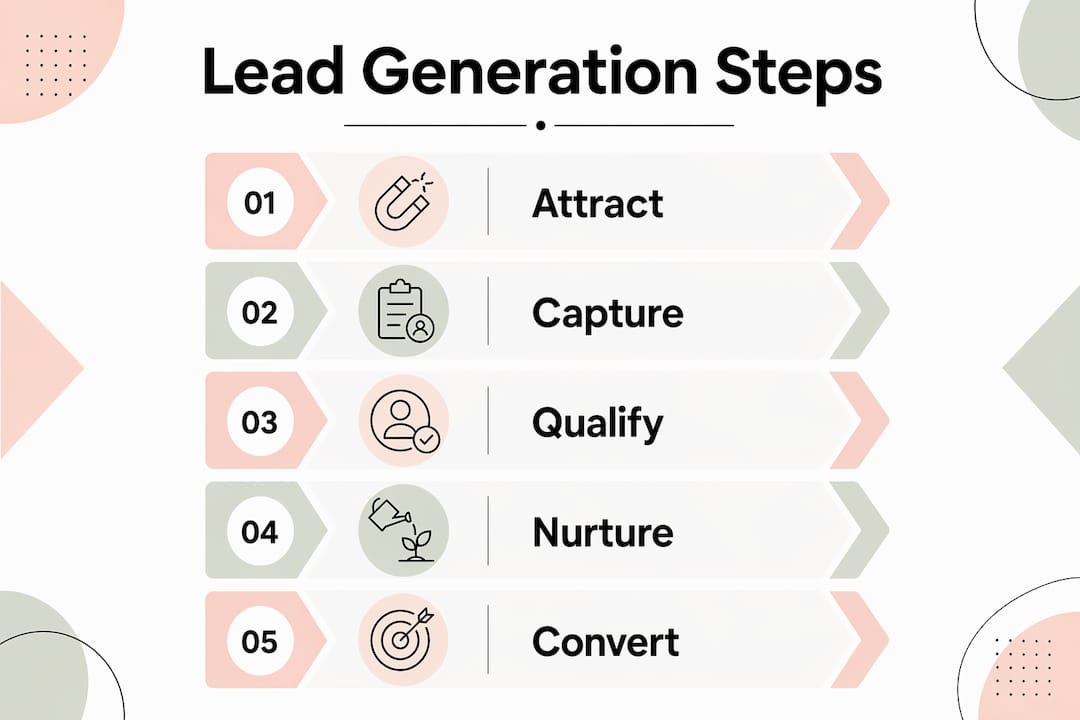
The mechanics follow a clear sequence. A visitor arrives via Google search, a paid ad, or a social media post. They land on a page designed to address their specific need. A conversion mechanism prompts them to take action. Their details are captured and passed to your sales or follow-up process.
The conversion mechanisms that drive this process include:
- Landing pages built around a single offer or service, with no distracting navigation
- Calls-to-action (CTAs) that are specific and intent-driven
- Gated content such as guides, checklists, or calculators that require an email address to access
- Pop-ups and slide-ins triggered by time on page or exit intent
- Live chat and AI chatbots that engage visitors in real time and qualify them before a human steps in
Targeted CTAs such as “Download a free trial” or “Book a meeting” consistently outperform vague prompts like “Contact us.” The specificity signals to the visitor exactly what they will get, which reduces hesitation and increases clicks. A generic contact form at the bottom of a page is passive. A CTA tied to a specific outcome is active.
Pro Tip: Place a conversion point within the first screen of your most visited pages. Visitors who do not see a clear next step within seconds will scroll past or leave entirely.
Once a visitor submits a form, their details flow into a CRM system such as HubSpot, Salesforce, or Microsoft Dynamics. From there, marketing automation tools trigger follow-up sequences, assign leads to sales team members, and track engagement. This integration is what separates a functioning lead generation system from a disconnected pile of spreadsheets.
MQL vs SQL: why does the distinction matter?
Not every lead is ready to buy. Distinguishing Marketing Qualified Leads (MQL) from Sales Qualified Leads (SQL) based on readiness to buy is one of the most practical improvements a business can make to its sales process.
An MQL has shown interest but is not yet ready for a sales conversation. They might have downloaded a guide, signed up for a newsletter, or visited your pricing page once. An SQL has demonstrated clear buying intent. They have requested a demo, asked for a quote, or visited your pricing page multiple times in a short period.
Here is how the distinction plays out in practice:
- A visitor downloads your “10 questions to ask before hiring a contractor” guide. They are an MQL. They need nurturing content, not a sales call.
- A visitor fills in your “Get a quote” form with a project description and a start date. They are an SQL. They need a call within the hour.
- A visitor books a discovery call directly through your calendar link. They are an SQL at the top of the priority list.
- A visitor opens three of your nurture emails and clicks through to your case studies page. They are transitioning from MQL to SQL and should be flagged for sales outreach.
Mismatched qualification, where sales treats all leads as sales-ready, wastes resources and damages trust with prospects who are not yet ready to buy. Properly distinguishing MQL and SQL ensures better pipeline management and a more respectful buyer experience.
Lead scoring formalises this process. You assign points to specific behaviours: a pricing page visit might score 10 points, a content download 5 points, and a direct enquiry 50 points. When a lead crosses a threshold, they are automatically routed to sales. This removes guesswork and keeps your sales team focused on the contacts most likely to convert.
What website lead generation strategies improve lead quality?
Generating more leads is straightforward. Generating better leads requires deliberate strategy. High-performing B2B lead generation websites use persona-based landing pages, UX optimisation, retargeting, and visitor intelligence rather than generic capture forms.
The most effective approaches include:
- Persona-specific landing pages. A plumber targeting commercial clients needs a different page than one targeting homeowners. Each persona has different concerns, language, and decision criteria. One generic services page serves neither well.
- Consistent messaging across channels. If your Google ad promises “same-day boiler repair in Manchester,” the landing page must deliver exactly that message. Mismatched messaging between ad and page is one of the most common reasons for high bounce rates and low conversion.
- Simplified forms. Optimising capture forms for minimal friction reduces abandonment and increases conversions. Ask only for what you need at that stage. Name, email, and one qualifying question is often enough to start the conversation.
| Strategy | Best for | Key benefit |
|---|---|---|
| Persona landing pages | Businesses with multiple customer types | Higher relevance, lower bounce rate |
| Gated content | Building email lists and nurturing | Captures intent-driven contacts |
| Retargeting ads | Recovering visitors who did not convert | Re-engages warm traffic cost-effectively |
| Live chat or chatbot | High-traffic pages with complex queries | Qualifies leads in real time |
| Click-to-call buttons | Mobile visitors and urgent service needs | Reduces friction for immediate enquiries |
Pro Tip: Mapping customer journeys with analytics tools like Google Analytics 4 or Microsoft Clarity reveals exactly where visitors drop off before converting. Fix those pages first before spending more on traffic.
Visitor identification software combined with retargeting ads helps capture up to 98% of website visitors who do not convert immediately. Tools in this category identify which companies are visiting your site even when no form is submitted, allowing your sales team to proactively reach out. For B2B service businesses, this is a significant advantage over waiting passively for enquiries.
Multiple lead capture paths allow different types of visitors to convert according to their intent and stage in the buying process. A visitor researching options needs a guide or checklist. A visitor ready to act needs a quote form or a booking link. Offering only one path means you lose everyone who is not at that exact stage.
How to integrate lead generation with your sales and marketing tools
Capturing a lead is only the beginning. What happens in the minutes and hours after submission determines whether that lead converts or goes cold. Lead scoring and automation enable timely follow-up and efficient handoff from marketing to sales, increasing conversion rates across the pipeline.
A well-integrated system works like this:
- A visitor submits a quote request form on your website
- Their details are instantly added to your CRM (HubSpot, Salesforce, or a tool like Microsoft Dynamics)
- An automated thank-you email is sent within seconds, confirming receipt and setting expectations
- If the lead scores above your SQL threshold, a task is created for a sales team member to call within the hour
- If the lead is an MQL, they enter a drip campaign: a sequence of educational emails delivered over days or weeks, designed to build trust and move them towards a buying decision
- Engagement data (email opens, link clicks, page revisits) feeds back into the lead score, triggering escalation when the prospect is ready
| Automation trigger | Action taken | Purpose |
|---|---|---|
| Form submission | Instant thank-you email | Confirms receipt, builds trust |
| Lead score threshold reached | Sales task created | Prioritises warm leads for outreach |
| Pricing page visited twice | Lead score increased, sales alert | Flags high-intent behaviour |
| Drip email link clicked | Follow-up email sent | Continues nurturing sequence |
| No engagement after 30 days | Re-engagement email sent | Recovers dormant leads |
Automated lead scoring and routing facilitate immediate, relevant sales engagement, which closes more deals faster. The businesses that respond to enquiries within five minutes are significantly more likely to convert than those that respond within an hour. Automation makes that speed possible without requiring someone to watch an inbox around the clock. You can also track phone calls from website visitors as part of this system, ensuring calls are attributed correctly and followed up with the same discipline as form submissions.
Key takeaways
Website lead generation works when your site is built to capture, qualify, and route visitor intent through multiple conversion points connected to automated follow-up systems.
| Point | Details |
|---|---|
| Define your conversion points | Place specific CTAs and forms across multiple pages, not just a contact page. |
| Qualify leads before routing | Use MQL and SQL criteria to send the right leads to sales at the right time. |
| Reduce form friction | Ask only for essential information at each stage to increase submission rates. |
| Automate follow-up | Connect forms to CRM and email automation to respond within minutes, not days. |
| Use visitor intelligence | Retargeting and identification tools recover leads who leave without converting. |
What I have learned about lead generation after working with service businesses
Most service businesses I work with have the same problem: they have a website, they get some traffic, but the enquiries are inconsistent and often poor quality. The instinct is to spend more on ads. The actual fix is almost always on the website itself.
The single biggest mistake I see is treating lead generation as a one-off setup. You build a contact form, add a CTA, and assume the work is done. It is not. Lead generation is a continuous process of testing, measuring, and adjusting. A CTA that converts well in January may underperform in March when your audience’s priorities shift. Pages that rank well need conversion rate work, not just traffic.
The second mistake is relying on a single generic form for every visitor. A visitor who has just found you through a blog post is not in the same mindset as someone who clicked a “Get a quote” ad. Offering the same form to both is a missed opportunity. Segment your capture mechanisms by intent, and you will see immediate improvement in lead quality.
I also see businesses where website enquiries disappear into inboxes that nobody monitors consistently, or where leads are captured but never followed up because there is no system connecting the form to the sales process. The website is doing its job. The process behind it is not. Fixing that connection, through CRM integration and automation, is where the real gains are.
— Ben
How gtwelve helps you generate better leads from your website

gtwelve builds conversion-focused websites for UK service businesses, trades, and SMEs that are designed from the ground up to capture and qualify enquiries. Every site we build includes targeted CTAs, optimised contact and quote forms, and integration with your existing tools, whether that is Microsoft 365, a CRM, or a calendar booking system.
We also connect your website lead capture to automated follow-up workflows, so every enquiry is acknowledged instantly and routed to the right person without manual effort. If you want a website that generates consistent, qualified leads and feeds them directly into your sales process, get in touch with gtwelve to discuss what that looks like for your business.
FAQ
What is the difference between a lead generation website and a brochure site?
A brochure site provides information about your business but does not actively prompt visitors to take action. A lead generation website uses forms, CTAs, gated content, and multiple conversion points to capture visitor details and feed them into a sales or follow-up process.
How do I generate leads online without paid advertising?
SEO-optimised service and location pages, gated content such as guides or calculators, and AI chatbots for websites all generate leads organically. The key is matching your content to the specific questions your prospects are searching for, then offering a clear next step on every page.
What is a good lead capture rate for a website?
Conversion rates vary by industry and traffic source, but most service business websites convert between 1% and 5% of visitors into leads. Targeted landing pages with specific CTAs and minimal form fields consistently outperform general pages with vague prompts.
How does lead scoring work in practice?
Lead scoring assigns numerical values to visitor behaviours, such as visiting a pricing page, opening emails, or submitting a form. When a lead’s total score crosses a set threshold, they are automatically flagged for sales outreach or moved into a more targeted nurture sequence.
Why do website enquiries sometimes not convert into customers?
The most common reasons are slow follow-up, poor lead qualification, and a mismatch between what the website promises and what the sales process delivers. Lead capture automation and CRM integration address the first two issues directly by ensuring every lead is acknowledged and routed correctly within minutes of submission.
Recommended
If this sounds like your website, we can take a look.
Note 53 of 72