Why about pages matter for SMEs: a 2026 guide
14 July 2026 · 3 min read
Why about pages matter for SMEs: a 2026 guide

An About page is the section of your website where visitors decide whether to trust you enough to get in touch. Understanding why about pages matter for SMEs is not a minor concern. 65% of all website visitors click on the About page, making it one of the most visited sections on any SME website. Visitors who land there show stronger buying intent and may spend up to 22.5% more than those who do not. For UK small businesses competing on trust rather than price, this page is one of the highest-value assets you have.
Why about pages matter for SMEs: the trust case
Your About page exists to answer one question every visitor is silently asking: “Can I trust these people with my problem?” Visitors do not arrive on your About page out of curiosity. They arrive because they are close to making a decision and need confirmation that your business is the right choice.

Well-structured About pages that address customer anxieties and values increase trust by 40% and boost time spent on the page by 32%. That is not a marginal gain. It is the difference between a visitor who enquires and one who quietly leaves for a competitor.
The mechanism behind this is straightforward. Visitors scan your About page for signals: Do you understand my situation? Do your values match mine? Are you a real business with real people behind it? 82% of modern consumers prioritise supporting businesses whose values align with their own. A vague or generic About page fails this test immediately.
Authentic photography plays a larger role than most SME owners expect. Genuine photos of real team members build credibility in seconds. Stock images do the opposite. They signal that the business is hiding behind a polished facade rather than showing up as a real organisation.
Pro Tip: Write your About page with a 70/30 split. Dedicate 70% of the content to your visitor’s world: their challenges, their goals, and why your service exists to help them. Reserve only 30% for your story. Most SMEs do this in reverse, and it costs them enquiries.
The language you use matters as much as the structure. Specific, plain language that mirrors how your customers describe their own problems builds connection faster than any mission statement. Phrases like “we help tradespeople stop losing leads to missed calls” land harder than “we are committed to delivering excellence.”
How does your About page affect AI and search engine visibility?
Search engines and AI tools do not just index your service pages. They read your About page to understand who you are as a business. AI-powered search tools evaluate About pages for identity and credibility signals. Pages that lack clarity limit your overall SEO reach, even when your other content is strong.
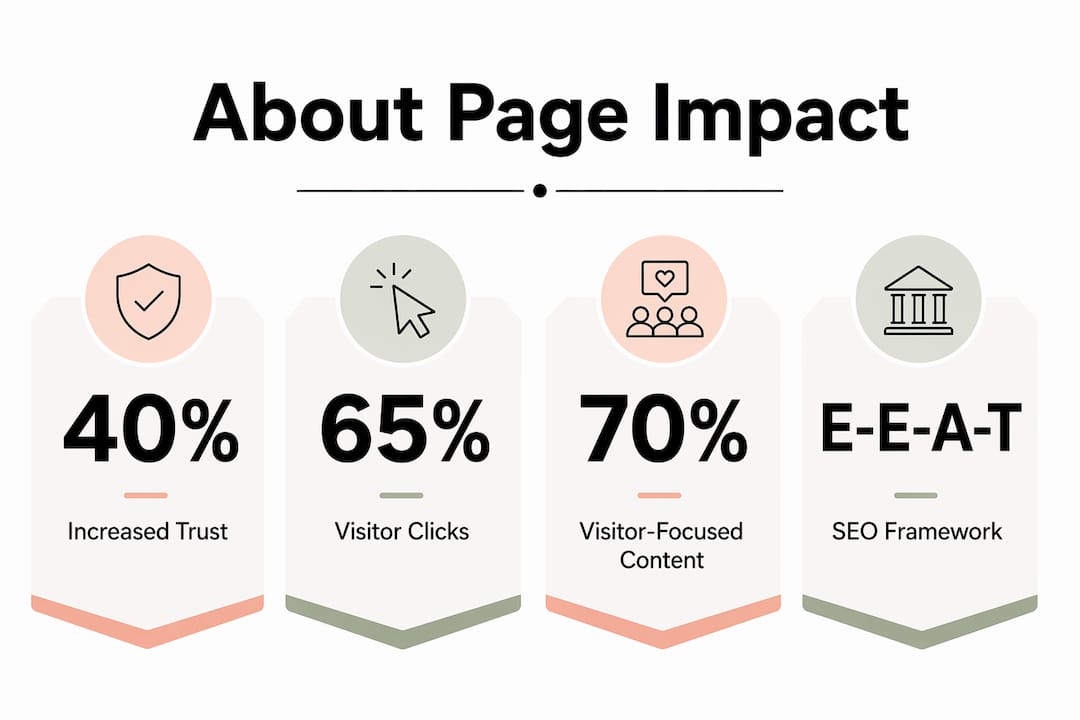
Google’s E-E-A-T framework (Experience, Expertise, Authoritativeness, and Trustworthiness) relies heavily on what your About page communicates. A page that names your leadership team, lists your location, and explains your track record gives Google concrete signals to work with. A page that says “we are passionate about what we do” gives it almost nothing.
Structured, consistent details about leadership and location embedded in About pages support AI’s ability to anchor your business identity online. This matters because AI search tools like Perplexity and Google’s AI Overviews pull from pages they can verify. If your About page is vague, you are invisible to these tools. You can read more about how these tools work in gtwelve’s guide to AI-powered search.
Structured data markup (also called schema markup) is a technical layer you add to your About page’s code. It tells search engines your business name, address, founder, and founding date in a format they can read directly. Using structured data markup on About pages helps AI search engines verify and connect your business identity across platforms.
Pages with clear question headings improve visibility in voice and AI-driven searches through Answer Engine Optimisation (AEO). This means structuring your About page with headings like “Who are we?” or “What areas do we cover?” rather than generic labels like “Our story.”
Pro Tip: Add a short FAQ section to your About page using real questions your customers ask before hiring you. This directly feeds AI search tools and increases your chances of appearing in featured answers.
| About page element | SEO and AI benefit |
|---|---|
| Named founder and team | Supports E-E-A-T authoritativeness signals |
| Business address and service area | Anchors local search identity |
| Schema markup | Verifies entity details for AI tools |
| Question-based headings | Improves AEO and voice search visibility |
| Consistent brand language | Reinforces entity recognition across platforms |
Common mistakes SMEs make on their About pages
Most SME About pages fail not because of poor design but because of poor focus. The most common mistake is treating the About page like a corporate biography. A list of founding dates, company milestones, and award logos tells the visitor nothing about why they should choose you over anyone else.
Here are the pitfalls that cost UK SMEs the most enquiries:
- Founder fatigue. The page becomes entirely about the business owner’s personal journey. Visitors care about their own problem first. Your story earns attention only after you have shown you understand theirs.
- No call to action. The About page is often a visitor’s highest-intent page, with potential customers close to contacting you. Leaving no clear next step wastes that traffic entirely.
- Generic language. Phrases like “quality service” and “customer-focused approach” appear on thousands of websites. They carry no weight because they prove nothing.
- No proof. Only 12% of small business About pages include quantifiable client results, despite evidence this boosts engagement by 28%. Naming a client outcome, a project scale, or a measurable result changes the page from a claim into evidence.
- Outdated content. An About page that references “our team of three” when you now employ twelve signals neglect. Visitors notice, and it undermines confidence.
Pro Tip: Read your About page out loud and count how many times you use the word “we” versus “you.” If “we” wins by a wide margin, rewrite it from the visitor’s perspective first.
Messaging that aligns clearly with visitors’ values and pain points builds trust faster than any company history. The fix is not complicated. It requires shifting the frame from “here is our story” to “here is why we exist for people like you.”
How to create an effective About page that converts and ranks
A well-built About page follows a clear structure. Each element earns its place by moving the visitor closer to contacting you. gtwelve recommends this sequence for UK SMEs:
- Positioning statement. Open with one or two sentences that describe who you help and what outcome you deliver. This confirms to the visitor they are in the right place within seconds.
- Visitor-focused narrative. Describe the problem your customers face before you introduce your business. This is where the 70/30 rule applies. Dedicating approximately 70% to customer needs and 30% to your story produces the strongest engagement and trust.
- Founder or team introduction. Keep this brief and human. Include a genuine photo, your name, and one or two sentences about why you started the business. Authenticity here outperforms polish.
- Proof section. Include at least one concrete result. A client name with permission, a project scale, a number of years in business, or a specific outcome all work. Avoid vague testimonials with no context.
- Clear call to action. Tell the visitor exactly what to do next. “Book a free call,” “Request a quote,” or “See our work” are all direct and effective. Link this to a relevant page, such as your testimonial page or contact form.
For SEO and AI visibility, add schema markup to the page’s code, use question-based subheadings, and keep your business name, location, and service description consistent with what appears on Google Business Profile and other directories. gtwelve’s guide to AI-friendly website content covers this in more detail.
Measure success by tracking time on page, enquiry form completions, and the ratio of About page visits to contact page visits. If visitors read your About page but do not proceed to contact you, the call to action or proof section needs work. Revisit the page every six months and update any figures, team details, or client results that have changed.
Key takeaways
An About page is one of the highest-converting pages on an SME website when it addresses visitor anxieties, communicates clear values, and ends with a direct call to action.
| Point | Details |
|---|---|
| About pages drive high-intent visits | 65% of visitors click the About page, and those visitors show stronger buying intent. |
| Trust increases with targeted messaging | Well-structured About pages increase trust by 40% and time on page by 32%. |
| AI and search engines rely on About pages | Clear identity signals, schema markup, and question headings improve AI and SEO visibility. |
| Proof converts browsers into enquiries | Only 12% of SMEs include quantifiable results, yet doing so boosts engagement by 28%. |
| Structure determines conversion | Use a positioning statement, visitor-focused narrative, proof, and a clear call to action. |
About pages are the most undervalued page on your website
I have reviewed hundreds of SME websites over the years, and the pattern is almost always the same. The homepage gets obsessed over. The service pages get rewritten. The About page gets a paragraph typed in ten minutes and never touched again.
That is a significant missed opportunity. The About page is where visitors go when they are genuinely considering hiring you. They are not browsing. They are evaluating. And yet most SMEs hand them a corporate biography that answers none of their real questions.
What I have seen work, consistently, is when a business owner stops writing about themselves and starts writing about the person they want to help. The moment the page shifts from “here is our history” to “here is what we understand about your situation,” the enquiry rate changes. Not slightly. Noticeably.
The AI dimension makes this even more pressing in 2026. Search tools now read your About page to decide whether your business is credible enough to recommend. A vague, outdated page does not just fail visitors. It signals to AI tools that your business is not worth surfacing. That is a compounding problem that gets harder to fix the longer you leave it.
My honest advice: treat your About page as a sales page with a human face. Give it the same attention you would give a paid advert. Update it when your business changes. Add real proof. Make the call to action obvious. The return on that investment is higher than most SME owners expect.
— Ben
Professional About page support for UK SMEs
Your About page should be working as hard as any other part of your website. If it reads like a corporate bio rather than a trust-building asset, you are leaving enquiries on the table.
gtwelve builds conversion-focused websites for UK service businesses, including About pages designed to build credibility, satisfy AI search signals, and turn high-intent visitors into real enquiries. We combine content strategy, technical SEO, and clear messaging to make every page on your site earn its place. If your About page is not converting visitors into contacts, get in touch with gtwelve to find out what a properly built page can do for your business.
FAQ
What is an About page and why does it matter for SMEs?
An About page is a dedicated website section that communicates who your business is, what you do, and why customers should choose you. For SMEs, it is one of the most visited pages on the site and a primary driver of trust and enquiries.
How does an About page affect my Google ranking?
Google’s E-E-A-T framework uses About page content to assess your business’s expertise and trustworthiness. Clear details about your team, location, and track record, combined with schema markup, improve your credibility signals and search visibility.
What should an SME include on its About page?
An effective About page includes a positioning statement, a visitor-focused narrative, a brief founder or team introduction with genuine photos, at least one concrete proof point, and a clear call to action directing visitors to the next step.
How often should I update my About page?
Review your About page every six months. Update team details, client results, and any figures that have changed. An outdated page signals neglect and reduces trust with both visitors and AI search tools.
Does an About page help with AI search tools like Perplexity?
Yes. AI search tools evaluate About pages for identity and credibility signals. Pages with consistent business details, schema markup, and question-based headings are more likely to be recognised and recommended by AI-driven search results.
Recommended
If this sounds like your website, we can take a look.
Note 10 of 72