Why trades need websites: your 2026 guide
24 May 2026 · 3 min read
Why trades need websites: your 2026 guide

Most people assume that having a few good reviews on Google is enough to win work. It is not. Only 40% of local businesses have dedicated websites in 2026, yet 97% of consumers read online reviews before choosing a local service. That gap is costing trades real money. Understanding why trades need websites is not about following trends. It is about recognising where your potential customers go after they read something good about you, and making sure you are there when they arrive.
Table of Contents
Key takeaways
| Point | Details |
|---|---|
| Websites outperform social profiles | You own the content and it works around the clock without algorithm interference. |
| Reviews start the journey, not end it | 66% of consumers research further after positive reviews before committing to a booking. |
| AI search depends on website content | AI tools now pull from website data, making a detailed site critical for local visibility. |
| Mobile and local SEO are non-negotiable | Trades websites must load fast, rank locally, and guide visitors to contact you quickly. |
| A website converts interest into leads | The right content reduces trust friction and turns curious visitors into paying customers. |
Why trades need websites more than ever
The question used to be whether a trades business needed a website at all. In 2026, the question is what you are losing without one.
Think about what happens after someone finds you on Google Maps or reads your reviews on a platform like Checkatrade. Most people do not simply pick up the phone. They want to verify you. They look for a website that confirms you are professional, local, and capable of doing what they need. When they find nothing, or worse, a bare social media page with no updates, the trust you built through those reviews evaporates.
Your website is the only digital asset you fully own. Social media platforms change their algorithms, restrict your reach, and can suspend accounts without notice. A website sits on your own domain, under your control, 24 hours a day. It keeps working while you are on site, generating leads and answering questions even when you are not actively promoting yourself.
The importance of websites for trades goes beyond just being visible. It is about controlling the narrative. Your website tells your story the way you want it told, with the services you actually offer, the areas you cover, and the proof that you deliver. No third-party platform does that for you.
Pro Tip: List your key services, your service area, and one or two specific examples of completed work right on your homepage. Visitors decide within seconds whether you are relevant to them.
Here is what a well-structured trades website achieves:
-
Confirms your credentials and accreditations clearly
-
Highlights your service area so local customers know you can reach them
-
Displays photos of completed work to replace any lingering doubt
-
Gives visitors a direct, frictionless way to contact you or request a quote
-
Mirrors the positive things customers already say about you in reviews
That last point matters more than most tradespeople realise. When a website content mismatch exists between what reviews promise and what a site delivers, consumers drop off. Your website needs to reinforce the reputation you have already earned.
What consumers do after reading your reviews
Here is the part that surprises most tradespeople. A good review does not close a sale. It opens a door.
66% of consumers conduct more research after reading positive reviews before they make a booking. Only 34% act immediately. That means for every three enquiries you might receive from strong reviews, two of those people are still looking for more before they commit.
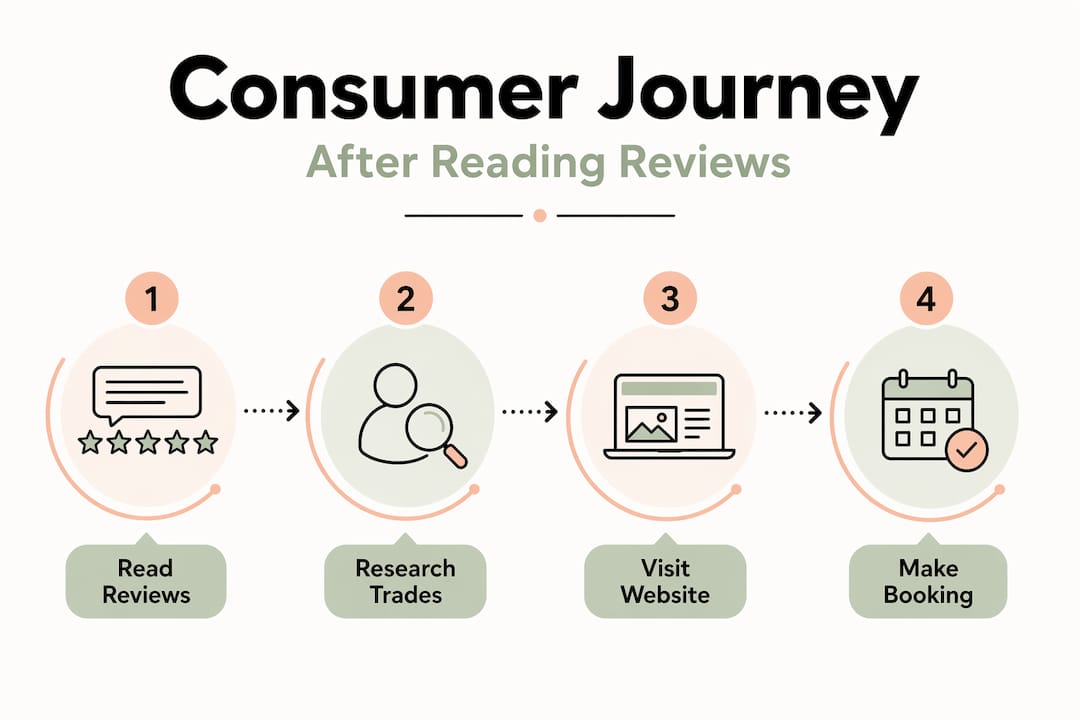
What are they looking for? They visit multiple review platforms. Consumers use an average of six review sites before making a decision. They check social media. And critically, 54% visit the business website after reading positive reviews. If your website does not exist or is outdated, you lose those leads entirely.
This is the core reason why contractors need a website. Reviews start the purchase journey. Your website has to finish it. The site needs to supply additional proof and make taking the next step as simple as possible.
What does that additional proof look like in practice?
-
Portfolio or project photos: Before and after images from real jobs you have completed in the local area build instant credibility.
-
Clear service descriptions: Spell out exactly what you do. A homeowner searching for a kitchen fitter needs to see that specific service listed, not just “general building work.”
-
Customer testimonials on your own pages: Reviews hosted on your site sit in your control and remain visible regardless of what third-party platforms do.
-
Frequently asked questions: Address common concerns upfront. How quickly can you respond? Do you offer fixed-price quotes? Are you insured?
-
A single, clear call to action: One phone number or one quote request form. Make it impossible to miss.
Reviews build trust at a distance. Your website closes the gap.
Website design and SEO for trade businesses
Having a website is not the same as having a website that works. The benefits of trade websites only materialise when the site is built properly.
For trades, local SEO is the single most important technical factor. Your potential customers are searching for things like “electrician in Sheffield” or “roofer near me.” Your website content needs to reflect those searches directly. Service pages built around specific trades and locations perform far better than a single generic homepage.
Here are the core requirements for a trades website that actually generates enquiries:
-
Mobile optimisation: The majority of local searches happen on mobile. A site that looks broken on a phone loses the lead before it starts.
-
Page speed: Slow sites get abandoned. Google also ranks faster sites higher in local search results.
-
Location-specific pages: If you work across multiple towns or boroughs, build a dedicated page for each. This dramatically improves local search visibility.
-
Testimonials and social proof on every key page: Do not bury your reviews. Put them where visitors see them without scrolling.
-
Simple contact options: Phone number in the header, a short contact form on every page, and ideally a WhatsApp link for customers who prefer messaging.
-
Up-to-date content: Stale websites signal an inactive business. Websites aligned with reviews and current offerings retain visitor confidence.
| Feature | Why it matters for trades |
|---|---|
| Mobile-first design | Most local searches happen on smartphones |
| Local keyword pages | Ranks for area-specific searches |
| Fast load speed | Reduces bounce rate and improves Google ranking |
| Clear contact options | Reduces friction between interest and enquiry |
| Portfolio and testimonials | Converts sceptical visitors into confident leads |
Pro Tip: Build a separate page for every major service you offer. A plumber covering boiler installs, bathroom fitting, and emergency repairs should have three distinct pages, not one.
SEO for trades must combine local keywords, mobile responsiveness, site speed, and structured content aligned to what your customers are actually searching for. Getting all four right is what separates a website that generates leads from one that just exists.
AI search and what it means for your trades business
This is the development that most tradespeople have not yet considered, and it is reshaping the customer journey faster than anyone anticipated.
AI search usage for local businesses increased from 6% in 2025 to 45% in 2026. Adults aged 30 to 44 are leading this shift, with 64% using AI tools like ChatGPT to find local service recommendations. When someone asks an AI assistant “who is the best plumber in Bristol,” the AI does not browse social media profiles. It pulls from website content.
This changes the trades business online presence question significantly. Social profiles are largely invisible to AI search. Your website is not. A detailed, well-structured site gives AI tools the information they need to recommend you: your services, your location, your credentials, and your reviews.
Here is what this means practically:
-
Vague websites get ignored by AI. If your site only says “quality work at competitive prices,” an AI has nothing useful to extract and will not surface you.
-
Structured content wins. Pages that clearly state the service, the location, and the outcome you deliver are the ones AI tools pull from.
-
AI compresses the decision journey. A consumer can now get a shortlist of three recommended local tradespeople in seconds. If you are not on that list, the job goes elsewhere.
-
Website content needs to answer questions directly. Write your service pages as if you are answering a specific customer question. “We fit gas boilers in Leeds, covering all makes and models, with same-day call-outs available” is far more useful to an AI than “boiler specialists.”
Does every trade need a website in the AI era? Without question, yes. The businesses that do not have one are not just missing search traffic. They are invisible to an entirely new discovery channel.
Building or improving your trades website
The process does not need to be complicated. Start by being clear about what you want your website to do.
For most trades, the primary goal is lead generation. Every decision about the site should serve that goal. That means clear service descriptions, local content, customer proof, and a contact route that takes fewer than five seconds to find.
Here is what impactful content looks like for a trades site:
-
Service descriptions with real specificity: Not “plumbing services” but “boiler installation, repair, and servicing in Manchester and Salford.”
-
Location pages: One per area you serve, with local references and any area-specific experience you have.
-
Customer proof at the point of decision: Testimonials on your service pages, not just on a separate reviews page that visitors rarely reach.
-
A clear process explanation: Tell customers what happens when they contact you. A simple “1. Call us. 2. We quote. 3. We complete the work” removes uncertainty and increases conversion.
-
Updated content: Add a completed project or update a service description every few months to signal to both Google and visitors that you are active.
Pro Tip: Ask your best three customers if you can quote them directly on your website. Named testimonials with a first name and location carry significantly more weight than anonymous five-star ratings.
The concrete benefits of trade websites built with this approach are straightforward. You convert more of the interest you are already generating. You filter out time-wasters because the site answers common questions upfront. You stand out clearly from competitors who have nothing beyond a Google Maps listing. These are not theoretical gains. They are the direct result of giving potential customers what they need to make a decision.
My take on why trades undervalue websites
I have worked with enough trades businesses to spot the pattern. The ones that dismiss websites usually say one of three things: “I get all my work through word of mouth,” “I tried a website before and it did nothing,” or “I’m too busy to sort it.”
Word of mouth is brilliant. But it does not scale, and it does not protect you when a quiet period hits. The customers you get through referrals still check your website before they call. When they find nothing, some of them quietly go elsewhere.
As for websites that “did nothing,” that is almost always a content problem. A generic five-page site with stock photos and vague service descriptions does exactly nothing. A site built around specific services, specific locations, and real customer proof does a great deal.
The control issue matters most to me. Social media platforms are not on your side. They want your attention and your advertising budget. Your website is yours. It works for you without asking for anything in return. In a market where consumer trust in local businesses is built through multiple touchpoints, the one asset you fully control is too valuable to neglect.
I have seen tradespeople triple their inbound enquiries within three months of launching a properly built site. Not because they did anything different on the tools. Because they gave potential customers somewhere to land and a reason to get in touch.
— Ben
How Gtwelve helps trades get more from their website

At Gtwelve, we build websites specifically designed to do one thing well: turn interest into enquiries for trades and local service businesses. Every site we create is mobile-first, optimised for local SEO, and structured to perform in both traditional and AI-driven search environments.
We do not hand over a finished site and disappear. We align your website with your reviews, keep content current, and connect your enquiry forms into practical workflows covering quotes, follow-ups, and scheduling. The result is a website that actively supports your business rather than sitting idle.
If you are ready to give your trades business the online presence it deserves, speak to the team at Gtwelve. We offer a no-obligation conversation about what a properly built website could do for your enquiry volume and local reputation.
FAQ
Do tradespeople really need a website in 2026?
Yes. With 45% of consumers now using AI to find local services and 54% visiting websites after positive reviews, a dedicated site is a direct lead generation tool, not an optional extra.
Why can’t social media replace a trades website?
Social media platforms control your reach and can restrict your account without warning. A website is an asset you own, and its content is visible to AI search tools in a way that social profiles are not.
What should a trades website include?
At minimum: specific service descriptions, your service area, customer testimonials, project photos, and a clear contact option on every page. Location-specific pages significantly improve local search rankings.
How does a website help convert reviews into bookings?
Reviews start the purchase journey but most consumers research further before booking. A website that reinforces your reviews with proof, credentials, and clear next steps converts that interest into actual enquiries.
Does website SEO matter for local trades businesses?
Absolutely. SEO for trades combining local keywords, fast load speeds, and mobile responsiveness is what ensures your site appears when nearby customers are searching for the specific services you offer.
Recommended
If this sounds like your website, we can take a look.
Note 63 of 72