Why website copy matters for trades businesses
27 June 2026 · 3 min read
Why website copy matters for trades businesses

Website copy is the written content on your website that either turns a visitor into an enquiry or sends them straight to a competitor. For trades businesses across the UK, this distinction is the difference between a full diary and a quiet phone. Most tradie websites lose leads weekly because their copy fails to specify services, locations, or benefits clearly. Generic phrases like “professional electrical services” or “quality workmanship guaranteed” tell a potential customer almost nothing. Understanding why website copy matters for trades is the first step toward fixing it, and the fix is more straightforward than most business owners expect.
Why website copy matters for trades: the core case
Website copywriting is the practice of writing words on a webpage with the specific goal of converting a reader into a customer. For trades businesses, this is not the same as writing a brochure or a company profile. The purpose is conversion, not description.
Trade customers seek quick trust signals and clarity because of urgency and stress. A homeowner with a burst pipe or a failed boiler does not browse five websites and compare them carefully. They pick the first business that clearly states what it does, where it operates, and why it can be trusted. Your copy either captures that moment or loses it.

The importance of website content for trades goes beyond first impressions. Copy that is specific, local, and problem-focused does three things at once. It ranks better in local search, it builds trust faster, and it filters out time-wasting enquiries before they reach your phone.
Effective trade websites act as 24/7 sales assistants rather than static brochures. That framing matters. A sales assistant answers questions, addresses concerns, and guides a customer toward a decision. Your website copy should do exactly the same, at any hour, without you being present.
What makes website copy effective for trades businesses?
Strong website copy for trades has four defining characteristics: specificity, local relevance, problem-first messaging, and visible trust signals. Generic content fails on all four counts.
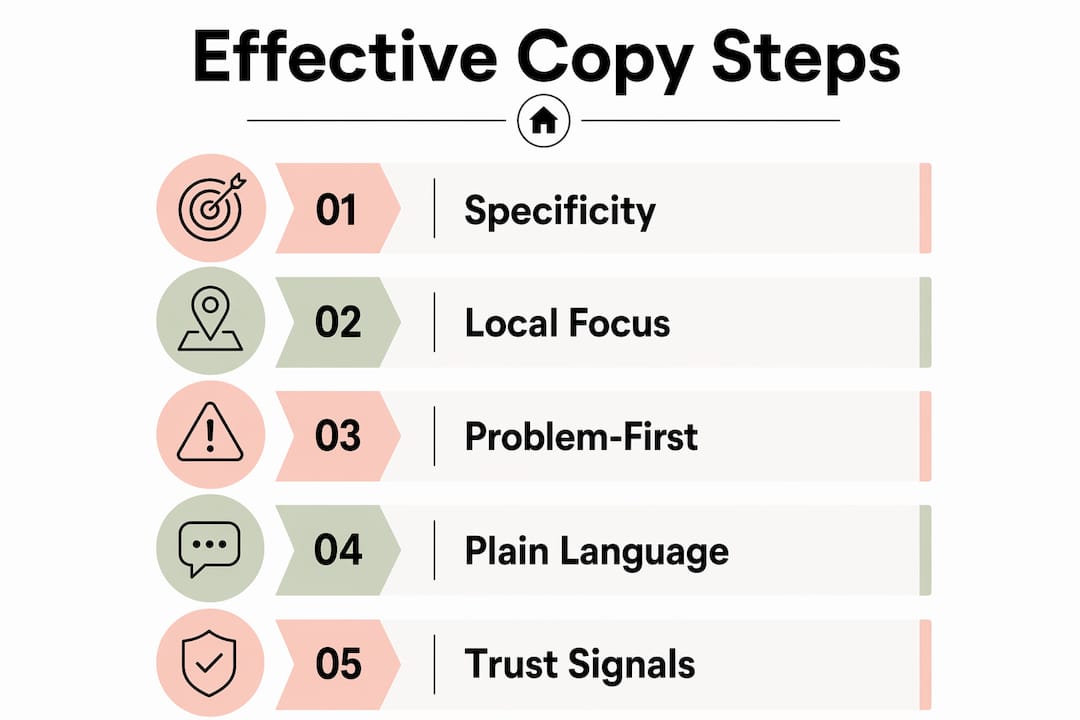
Specificity means naming the exact service, not a broad category. “Emergency boiler repair in Leeds” outperforms “heating services” every time. It matches what a customer types into Google, and it tells them immediately that you do the thing they need.
Local relevance means stating your service areas repeatedly and explicitly. Explicit mention of service areas throughout your website boosts local search relevance and customer confidence. Customers leave a website unsure whether you cover their area if you do not say so clearly. Uncertainty kills enquiries.
Problem-first messaging means your headline addresses the customer’s situation before it mentions your business. “Boiler broken? We cover emergency repairs across Manchester, same day” works far better than “Welcome to Smith Heating Ltd, established 2003.”
Trust signals are the details that reduce risk in a customer’s mind. These include:
- Accreditations and trade body memberships (Gas Safe, NICEIC, FMB)
- Verified customer reviews with names and locations
- Guarantees stated plainly, such as a one-year workmanship warranty
- A named contact or photo of the team
Pro Tip: Plain, confident language that sounds like a reliable local business converts better than formal corporate tone or overly casual chat. Write the way you would speak to a customer on the phone, then tighten it up.
How does website copy impact customer engagement and conversion?
Effective copy improves conversion through a simple mechanism: it removes doubt faster than weak copy does. The moment a visitor feels uncertain about whether you cover their area, handle their specific problem, or charge a fair rate, they leave.
Here is how well-written copy changes that outcome, step by step:
- Immediate clarity on services. A visitor lands on your page and reads a headline that names their exact problem. They do not need to scroll or guess. Engagement begins because the page feels relevant.
- Location confirmation. The copy states your service area within the first two paragraphs. The visitor knows you cover their town. They stay on the page.
- Trust built through specifics. Including pricing ranges, specific service capabilities, and service areas in your copy reduces irrelevant enquiries and attracts suitable jobs. A customer who sees “jobs from £150, no call-out fee within 10 miles of Bristol” self-qualifies before they pick up the phone.
- Social proof confirms the decision. A review from a named customer in a nearby town closes the loop. The visitor now trusts you and feels confident contacting you.
- A clear call to action removes friction. “Call now for a free quote” or “Book online in 2 minutes” tells the visitor exactly what to do next. Ambiguity at this stage loses the enquiry.
Focusing copy on solving customer problems rather than business history leads to higher enquiry rates. Copy that empathises with customer urgency converts better than copy about company background. This is the single most important shift a trades business can make to its website content.
The quality of enquiries also improves. Customers who read specific, detailed copy arrive with realistic expectations. They know your service area, your rough pricing, and what you specialise in. That saves you time on the phone and reduces the number of jobs that are not a good fit.
Common website copy mistakes trades businesses make
Most trades websites make the same handful of errors. Recognising them is the fastest way to understand where your own site may be losing work.
- Leading with company history. “Established in 1998, we are a family-run business…” tells a stressed customer nothing useful. They want to know if you can fix their problem today, not when you started trading.
- Using vague descriptors. Phrases like “high-quality service” and “competitive prices” appear on thousands of trade websites. They carry no weight because they are unverifiable and interchangeable.
- Ignoring local intent. A website that never names specific towns, postcodes, or boroughs will struggle in local search and will leave visitors unsure whether you serve their area.
- Burying the call to action. If your phone number or booking link appears only in the footer, you are making the customer work harder than necessary. Calls to action belong at the top of the page and after every key section.
- Weak or absent trust signals. A website without accreditations, reviews, or guarantees asks a customer to take a leap of faith. Most will not.
Pro Tip: Rewrite your homepage headline by completing this sentence: “We help [specific customer] with [specific problem] in [specific location].” That single sentence, placed at the top of your page, will outperform most existing trade website headlines.
Successful tradie copy leads with empathy, acknowledging customer stress and urgency before proposing solutions. A plumber’s homepage that opens with “Burst pipe? Blocked drain? We cover emergency call-outs across Birmingham within the hour” speaks directly to the customer’s state of mind. That connection is what keeps them on the page.
Practical steps to write website copy that drives results
Writing effective copy for your trades website does not require a marketing degree. It requires a clear understanding of your customer, your services, and your location. Follow these steps to build copy that converts.
- Start with your customer’s urgent problem. Before you write a single word about your business, write down the top three problems your customers call you about. Those problems become your headlines.
- Name your services specifically. Create a separate page for each core service. “Bathroom refurbishment” and “emergency leak repair” are different services with different customers. Treat them that way. High-performing trade websites use service-specific pages rather than generic service listings to better target search intent.
- State your service area on every page. List the towns, cities, and postcodes you cover. Do this in the body text, not just the footer. Repeat it naturally throughout the page.
- Add trust signals throughout, not just on a dedicated page. Accreditations, review snippets, and guarantees belong on your homepage, your service pages, and your contact page.
- Write a clear call to action for every page. Each page should end with one specific next step. “Call us on [number]”, “Request a free quote”, or “Book your survey online” are all clear and direct.
The table below shows the difference between weak and strong copy patterns for a typical trades page:
| Copy element | Weak version | Strong version |
|---|---|---|
| Headline | “Professional plumbing services” | “Emergency plumber in Sheffield, available today” |
| Service description | “We offer a range of plumbing solutions” | “We fix burst pipes, blocked drains, and leaking radiators” |
| Location | Not mentioned | “Covering Sheffield, Rotherham, and Barnsley” |
| Trust signal | “Quality guaranteed” | “Gas Safe registered. 5-star rated on Google by 140 customers” |
| Call to action | “Contact us” | “Call now for a same-day quote: 0114 XXX XXXX” |
For a broader view of how your website structure supports your copy, the gtwelve guide on trade website must-have pages covers the pages every trades site needs to convert visitors effectively.
Key takeaways
Effective website copy is the single most controllable factor in how many enquiries a trades business generates from its website.
| Point | Details |
|---|---|
| Specificity converts | Name exact services and locations rather than using broad category labels. |
| Local intent drives trust | State your service areas repeatedly on every page to confirm coverage and boost local search. |
| Problem-first copy wins | Lead with the customer’s urgent problem, not your company history or credentials. |
| Trust signals reduce doubt | Include accreditations, reviews, and guarantees throughout the site, not just on one page. |
| Clear calls to action close enquiries | Every page needs one specific next step that tells the visitor exactly what to do. |
The underestimated power of words on a trades website
I have reviewed hundreds of trades websites over the years, and the pattern is almost always the same. The business owner has invested in a decent design, maybe even paid for professional photos, but the words are an afterthought. They read like a company profile written in a hurry, full of phrases that sound professional but say nothing specific.
Here is what I have found to be true: design gets a visitor to stay for three seconds. Copy is what keeps them there for three minutes and makes them pick up the phone. A beautifully designed website with vague copy will consistently underperform a plainer site with sharp, specific, customer-focused writing.
The resistance I hear most often is “I’m a tradesman, not a writer.” That is fair. But you do not need to be a writer. You need to know your customer’s problem, your service area, and what makes you reliable. Put those three things at the top of every page in plain English, and you are already ahead of most of your competitors.
The other thing I would push back on is the idea that copy is a one-time job. Your services change, your service area may expand, and customer language evolves. A conversion-focused website treats copy as something that gets reviewed and refined, not written once and forgotten. The businesses I see growing consistently are the ones treating their website as a live sales tool, not a static business card.
— Ben
How gtwelve helps trades businesses turn copy into enquiries
If your website is not generating the volume or quality of enquiries you need, the words on your pages are usually the first place to look.

gtwelve works with UK trades and service businesses to build websites that are written to convert, not just to look professional. That means service-specific pages, locally targeted copy, trust signals in the right places, and calls to action that actually get clicked. Every website gtwelve builds is connected to practical business systems, so enquiries flow directly into your calendar, quote workflow, or follow-up process without extra admin on your part. If you want a website that works as hard as you do, see what gtwelve offers for trades businesses across the UK.
FAQ
Why does website copy matter more than website design for trades?
Design earns a visitor’s attention for a few seconds. Copy is what convinces them to stay and make contact. A well-designed site with vague copy will lose enquiries that a plainer site with specific, clear writing would capture.
What is the biggest copy mistake trades businesses make?
Leading with company history instead of the customer’s problem is the most common error. Copy that empathises with customer urgency and offers clear solutions converts significantly better than copy about when the business was founded.
How often should a trades business update its website copy?
Copy should be reviewed at least twice a year, or whenever your services, pricing, or service areas change. Treating your website as a live sales tool rather than a static page keeps it relevant and effective.
Does mentioning service areas really make a difference?
Yes. Repeated explicit mention of service areas noticeably increases customer trust and contact rates. Customers who are unsure whether you cover their area will simply leave rather than call to ask.
How do I write a homepage headline that converts?
Complete this sentence: “We help [specific customer] with [specific problem] in [specific location].” Use that as your starting point. Specific, location-aware headlines consistently outperform generic ones for trades businesses.
Recommended
If this sounds like your website, we can take a look.
Note 27 of 72