How to create a content plan for your local business
23 July 2026 · 3 min read
How to create a content plan for your local business

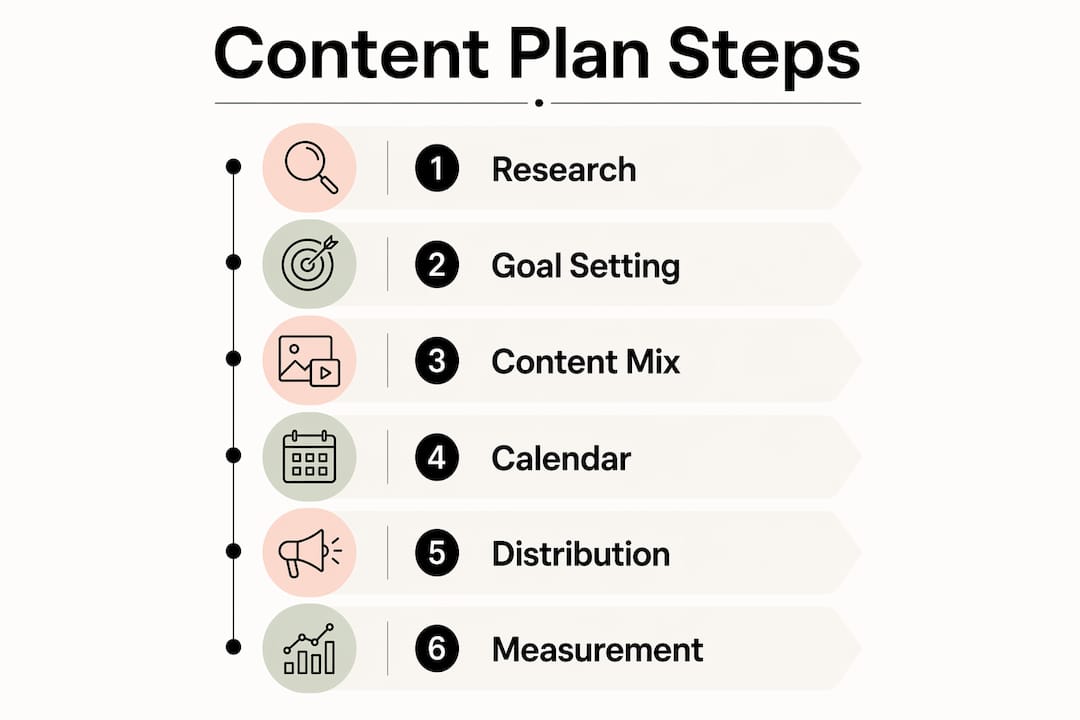
A practical local business content strategy comes down to seven clear steps: research your audience, set measurable goals, choose your content mix, build a calendar, select your channels, create efficiently, and measure results. Get those seven steps right and your content stops being a chore and starts generating enquiries.
Here is the blueprint:
- Step 1: Research your local audience and build customer personas
- Step 2: Set specific, measurable goals tied to business outcomes
- Step 3: Choose content types and plan thematic campaigns
- Step 4: Build a content calendar with seasonal timing
- Step 5: Select and prepare your distribution channels
- Step 6: Create content efficiently with a repeatable workflow
- Step 7: Measure performance and refine your plan monthly
Each step is covered in detail below, with practical examples built for small UK businesses in 2026.
What is a content strategy and why does your local business need one?
A content strategy is a plan for what you publish, where you publish it, and why. It connects every blog post, social update, and Google Business Profile (GBP) post to a specific business goal, whether that is attracting new enquiries, building trust with local customers, or ranking higher in local search.
Without a plan, most small businesses publish sporadically and wonder why nothing sticks. With one, every piece of content has a job to do.
The commercial case is clear. More than 80% of consumers use online search to find local businesses, yet most local companies publish generic content that could belong to anyone, anywhere. A focused local business content strategy fixes that gap by making your content unmistakably relevant to your area and your customers.
For a small UK business, the benefits are concrete: more visibility in local search results, stronger trust with nearby customers, and a steady pipeline of enquiries that does not depend on paid advertising.
How do you set goals and align content with what your customers need?
Vague goals produce vague results. Before you write a single word, decide exactly what you want your content to achieve and connect each goal to something your customers are actively looking for.
-
Set specific, measurable goals. Choose targets you can track: monthly organic website visits, number of enquiry form submissions, Google rankings for specific local search terms, or GBP profile views. “Get more traffic” is not a goal. “Reach 500 organic sessions per month from local search within six months” is.
-
Research what your customers actually ask. Pull questions from Google Search Console query data, your own enquiry forms, and Google’s “People Also Ask” boxes for your main service keywords. The highest-converting content answers specific questions about cost, process, and comparisons, not generic industry news.
-
Map content to the customer journey. A customer searching “how much does a boiler service cost in Leeds” is closer to buying than one searching “how does a boiler work.” Plan content for both stages: demand posts that capture people ready to book, and authority posts that build trust with those still researching.
-
Prioritise topics with commercial intent. A post titled “Boiler service cost in Sheffield: 2026 pricing guide” will generate more enquiries than “5 boiler maintenance tips.” Specific, local, cost-focused content connects directly to buying decisions.
-
Align topics with your service pages. Every blog post should link to a relevant service or location page, and those pages should link back. This bidirectional linking is one of the most underused tactics in local SEO for small businesses.
How do you choose your content mix and plan thematic campaigns?
The most effective local content mixes several formats, each serving a different purpose. Choosing the right mix depends on your audience, your resources, and the platforms where your local customers spend time.
Content types that work for local UK businesses:
- Local how-to guides and blog posts: Evergreen content that answers specific local questions and builds long-term search traffic. A plumber in Bristol writing “How to deal with a frozen pipe in a Victorian terrace” speaks directly to a local problem.
- Location and service area pages: Dedicated pages for each area you serve. These are the highest-priority content assets for local SEO and should be built before anything else. See how location pages work for a practical guide.
- FAQ content: Structured answers to locally specific questions, optimised for Google’s “People Also Ask” boxes and AI Overviews.
- Google Business Profile posts: Weekly updates that include your target keywords and location. Treat your GBP as a publishing channel, not a static listing.
- Short videos: Behind-the-scenes clips, job walkthroughs, or local event coverage build trust quickly and perform well on Instagram Reels and YouTube Shorts.
- User-generated content: Customer photos, reviews mentioning your area, and community posts add authenticity that no brand-produced content can replicate.
Planning thematic campaigns keeps your content cohesive and easier to produce. Group posts around a monthly theme tied to local demand: a landscaper might run a “spring garden preparation” theme in february and march, a heating engineer might run a “boiler health check” theme in september. Themes give your audience a sense of what to expect and make batch-creating content far more efficient.
The key principle: every piece of content must have a clear function. Publishing more pages without purpose does not improve SEO. Unproductive pages can actively damage your site’s authority.

How do you build a content calendar with the right cadence and timing?
A content calendar turns your strategy into a schedule. The goal is consistency over volume: a steady output of well-targeted posts beats a burst of activity followed by months of silence.
Pro Tip: Publish seasonal content 8–12 weeks before the demand peak. Google needs time to crawl, index, and rank a new page. A “Christmas party venue in Manchester” post published in december is too late. Publish it in september.
The minimum viable cadence for a local content programme is two posts per month, which produces 24 posts per year. Each post of around 2,000 words typically takes 4–8 hours to research, draft, edit, and optimise. Plan your time accordingly.
| Month | Demand post | Authority post | Seasonal focus |
|---|---|---|---|
| January | “[Service] cost in [town]: 2026 guide” | “How [service process] works: step by step” | New year planning |
| February | “[Service A] vs [Service B]: which suits your home?” | “Signs you need [service] this winter” | Late winter demand |
| March | “Best [service provider] in [town]: what to look for” | “Common [problem]: causes and fixes” | Spring preparation |
| April | “[Service] near me: what to expect and how to book” | “How to prepare your [property] for spring” | Spring peak |
| May | “[Service] prices in [town]: what’s included?” | “DIY vs professional [service]: honest comparison” | Pre-summer |
| June | “Emergency [service] in [town]: response times” | “How long does [service] take?” | Summer demand |
Pair each demand post with an authority post and link them to each other. This creates tight two-page clusters that Google reads as evidence of genuine expertise.
Which channels should you use to distribute local content?
Publishing content on your website is only half the job. Getting it in front of local customers requires active distribution across the right channels.
- Your website blog: The foundation. All content should live on your main domain at
yourbusiness.com/blog, not a separate subdomain. This consolidates all SEO value in one place. - Google Business Profile: Repurpose every new blog post into a GBP post within 48 hours of publishing. This double-signals your location relevance to Google and gives Map searchers a reason to visit your site. Read gtwelve’s guide on optimising your GBP for practical setup steps.
- Social media: Choose one platform where your local customers are active and post 3–5 times per week. For most UK trade and service businesses, Facebook and Instagram deliver the best local reach. Repurpose blog content into shorter posts rather than creating everything from scratch.
- Email newsletter: A weekly or fortnightly email to your subscriber list keeps your business top of mind. Tie each newsletter to your latest blog post for consistency.
- Local directories and citations: Yelp, Yell, Checkatrade, and industry-specific directories extend your reach and build the citation signals that support local search rankings.
Each channel needs local signals baked in: your town or neighbourhood name, a clear call to action, and consistent NAP (Name, Address, Phone) details that match your GBP exactly.
How do you create content efficiently without wasting time?
Small businesses rarely have a dedicated content team. A clear workflow makes consistent publishing achievable without it consuming your week.
- Research the topic. Check Google Search Console for queries you already rank for, use Google Autocomplete and “People Also Ask” to find related questions, and note what your customers ask during enquiries.
- Write a brief before you draft. Decide the target keyword, the page type (blog post, location page, FAQ), the word count, and the internal links you will include. This prevents scope creep and keeps drafting focused.
- Draft with structure. Use a clear H1 that includes your location and service. Break the body into H2 and H3 sections. Write short paragraphs of two to four sentences. Structured content is easier for both readers and search engines to process.
- Edit for clarity and local relevance. Cut anything generic. Add specific local references: a nearby landmark, a local regulation, a community event. This is what separates content that ranks locally from content that ranks nowhere.
- Optimise before publishing. Add your target keyword to the title tag, H1, first paragraph, and at least one H2. Add schema markup for LocalBusiness, FAQ, or HowTo where relevant. Add internal links to at least two existing pages.
- Publish and distribute. Post to your blog, create a GBP update, share on social media, and send to your email list if the topic warrants it.
For scheduling and workflow management, tools like Google Sheets work perfectly well for a simple content calendar. If you manage bookings alongside content tasks, integrating your calendar with your appointment system saves time. Booking calendar integrations can help service businesses keep content and client schedules in one view.
How do you measure content success and keep improving?
Measuring content performance tells you what to do more of and what to stop. Without monthly tracking, you are guessing.
| Metric | What it tells you | How to track it |
|---|---|---|
| Organic sessions | Whether your content attracts search traffic | Google Search Console, GA4 |
| Local keyword rankings | Which posts rank for target terms | Google Search Console position data |
| GBP profile views | Whether local visibility is growing | GBP Insights dashboard |
| Enquiry form submissions | Whether content converts visitors to leads | GA4 goal tracking |
| Posts on page one | Percentage of published posts earning top rankings | Search Console performance report |
What to do with the data:
- Posts ranking in positions 6–15 are your highest-priority optimisation targets. Update them with additional depth, newer information, and stronger internal links.
- Posts generating traffic but no enquiries need a clearer call to action or a stronger link to a service page.
- Posts with no impressions after three months either target the wrong keyword or need more internal links pointing to them.
Review your content plan monthly for scheduling and keyword performance, and do a full strategic review every quarter to align with seasonal demand and ranking shifts.
How do you structure keyword architecture for maximum local SEO impact?
Most local businesses treat keywords as a list of phrases to sprinkle into posts. The businesses that rank consistently treat keywords as an architecture: a structured map of content types, each assigned a specific role.
Effective keyword organisation maps into three categories:
- High-priority location-based service pages: “Electrician in Nottingham,” “boiler installation Sheffield.” These are your commercial core and should be built first. See gtwelve’s guide to service area pages for how to structure them.
- Medium-priority local educational articles: “How much does rewiring a house cost in Nottingham?” These build topical authority and feed traffic to your service pages.
- Supporting comparison and review content: “[Service A] vs [Service B] in [town],” “best [service provider type] in [area].” These capture bottom-of-funnel searches from people almost ready to book.
The hub-and-spoke model ties these together. Each service page acts as a hub. Educational and comparison posts are the spokes, all linking back to the hub and to each other. This internal linking structure signals topical depth to Google and passes authority across your site. A pillar page approach formalises this into a clear site architecture.
| Content type | Keyword intent | Example |
|---|---|---|
| Service/location page | Commercial | “Roof repair in Leeds” |
| Educational blog post | Informational | “How long does a roof repair take?” |
| Comparison post | Decision-stage | “Roof repair vs full replacement: costs compared” |
| FAQ page | Informational/featured snippet | “How much does roof repair cost in Leeds?” |
Pro Tip: Use the neighbourhood or landmark names your customers actually use, not just the formal city name. A customer in Headingley searches “plumber Headingley,” not “plumber Leeds city centre.” Hyperlocal terms in your H1 and title tags boost local relevance in ways that city-level targeting alone cannot.
How do you research your local audience and build customer personas?
Good content starts with knowing exactly who you are writing for. Generic personas (“homeowners aged 25–55”) produce generic content. Specific personas produce content that converts.
Start with the data you already have. Review your last 20 enquiries: what did customers ask, what problem were they trying to solve, and which area did they come from? Patterns emerge quickly. A kitchen fitter in Manchester might find that most enquiries come from homeowners in specific postcodes asking about costs and timelines, not design trends.
Supplement this with Google Search Console query data, filtered by location. The actual phrases people use to find your site reveal far more about intent than any demographic survey. Tools like BrightLocal and Moz Local help identify the search terms your local audience uses across your target areas.
Build two or three simple personas based on what you find: a name, a location, a specific problem they need solved, and the question they type into Google. Every piece of content you plan should serve at least one of these personas directly. If a topic does not connect to a real customer question, it does not belong in your calendar.
How do you use local events and news for timely content ideas?
Local events and news give you a reliable source of timely content that generic competitors cannot replicate. A national brand cannot write authentically about the Harrogate Flower Show or the Bristol Harbour Festival. You can.
Monitor your local council’s events calendar, local Facebook groups, and regional news outlets for upcoming events, planning decisions, and community news relevant to your trade. A landscaper can publish “How to prepare your garden for the Chelsea Fringe festival season.” A letting agent can cover “What the new renter’s rights legislation means for landlords in Birmingham.”
The SEO benefit is secondary to the trust signal. Content that references real local events tells both Google and your customers that you are genuinely embedded in the community, not just a business that mentions the city name once per page. Local scent — including regional infrastructure references and community pain points — is what separates content that ranks locally from content that merely targets local keywords.
Keep a running list of local dates in your content calendar: school term dates, local market days, annual festivals, and planning consultation deadlines. These become your seasonal content hooks.
How does Google Business Profile fit into your content strategy?
Your Google Business Profile is a content platform, not a static listing. Businesses that publish consistent blog content and maintain active GBP posts rank higher in local pack results than those relying on their GBP alone.
Treat your GBP as a weekly publishing channel. Each post should include your target service keyword and location, a clear call to action, and a link back to a relevant page on your website. Repurpose every new blog post into a GBP update within 48 hours of publishing.
Beyond posts, complete every section of your profile: services with location-specific descriptions, a business description that leads with your primary service keyword and town name, and photo captions that describe what is shown and where. Pre-populate the Q&A section with the questions your customers ask most often, using keyword-rich answers.
Add LocalBusiness schema markup to every page on your website, not just your homepage. Schema tells Google your business name, address, phone number, opening hours, and service area in a structured format that directly supports your GBP rankings. For businesses serving multiple areas, each location page should carry its own schema with the specific area’s details.
How do you engage your local community through social media and user-generated content?
Social media works differently for local businesses than for national brands. The goal is not reach. The goal is recognition: becoming the business that locals think of first when they need your service.
Post content that is specific to your area: a job you completed in a local street, a shout-out to a neighbouring business, a comment on a local news story. Tag local landmarks, use local hashtags, and engage with community groups. This builds a social presence that feels genuinely local rather than broadcast.
User-generated content (UGC) is particularly powerful. Ask customers to share photos of completed work and tag your business. Encourage reviews that mention the specific area or street. A review that says “brilliant kitchen fitter in Chorlton” does more local SEO work than a generic five-star rating. Display location-specific reviews on the relevant service or location pages of your website, not just on a central testimonials page.
Respond publicly to every review. Your responses add fresh, indexed text to your GBP and demonstrate active community engagement. A business that replies to reviews consistently signals to Google that it is active and trustworthy in its local area.
How do you budget and allocate resources for local content?
Content marketing for small businesses does not require a large budget. It requires consistent time and a clear allocation of effort.
The honest time cost for a sustainable content programme: two blog posts per month at 4–8 hours each means 8–16 hours of content work per month. Add two to four hours for GBP posts, social media updates, and email newsletters. That is a realistic 10–20 hours per month for a complete local content operation.
If you cannot commit that time yourself, prioritise ruthlessly. Location and service pages deliver the highest return on investment and should be built first. Blog content compounds over time but takes longer to show results. GBP posts have the fastest impact on local pack visibility and take the least time to produce.
For businesses with a small budget for external help, the highest-value tasks to outsource are keyword research, content briefs, and technical SEO setup (schema markup, internal linking structure). Writing can follow a brief you create yourself, keeping costs down while maintaining quality.
Track your content spend against enquiries generated each quarter. Content that costs £200 to produce and generates three enquiries worth £500 each is a strong return. Content that generates no enquiries after six months needs to be revised or replaced.
Key takeaways
A local business content plan works when every piece of content has a clear goal, a specific local audience, and a measurable outcome tied to enquiries or rankings.
| Point | Details |
|---|---|
| Publish consistently | A minimum of two posts per month, each taking 4–8 hours, builds sustainable local search authority. |
| Use keyword architecture | Map content into three tiers: service pages, educational posts, and comparison content for maximum local SEO impact. |
| Time seasonal content early | Publish seasonal posts well before the demand peak so Google has time to rank them. |
| Treat GBP as a channel | Repurpose every blog post into a GBP update within 48 hours to reinforce local relevance signals. |
| Measure and refine monthly | Track organic sessions, local rankings, and enquiry form submissions to identify what to improve. |
Recommended
If this sounds like your website, we can take a look.
Note 01 of 72