How AI improves website content in 2026
2 June 2026 · 3 min read
How AI improves website content in 2026

AI content optimisation is the practice of using artificial intelligence tools to enhance the quality, structure, and search performance of website content. For website owners and digital marketers, understanding how AI improves website content is no longer optional. Google’s AI-driven search features now surface results based on content clarity, originality, and technical structure, meaning sites that ignore these signals lose visibility to those that do not. Tools like Grammarly, WriterSEO, and ChatGPT are already helping businesses produce content that ranks, engages, and converts more effectively.
How does AI improve website content quality and uniqueness?
The single most important factor in AI-driven content discovery is originality. Google’s optimisation guide states that creating content based on your own perspectives and organising it with clear headings increases the chances of being cited in AI search results. This is a direct signal that generic, recycled content will not perform.
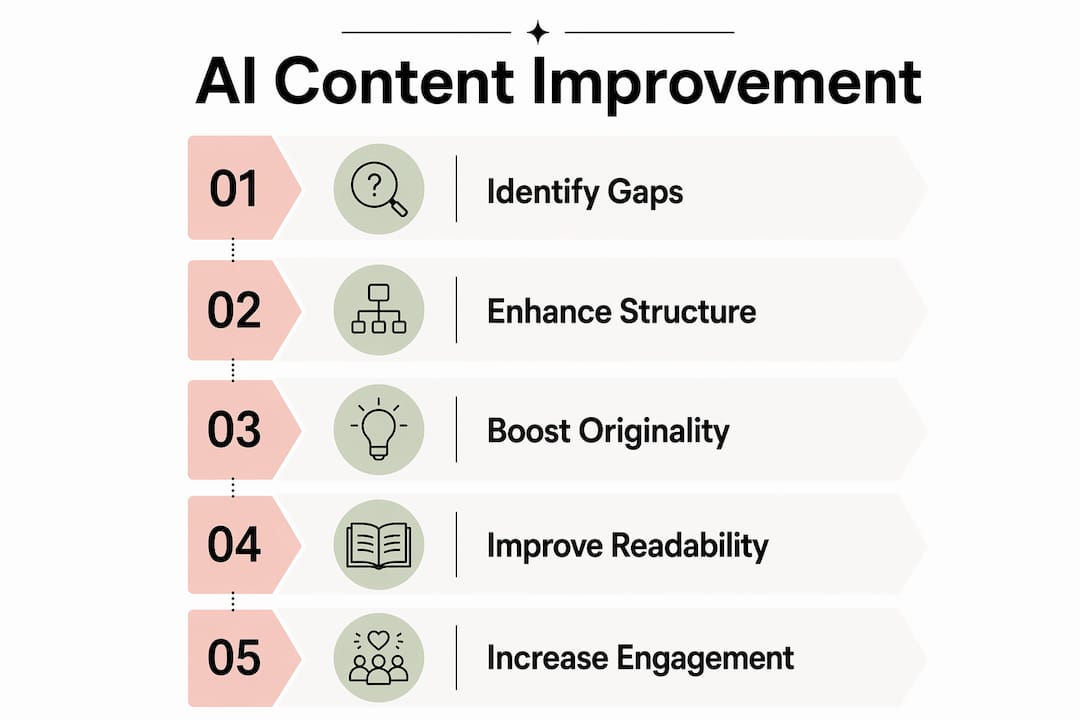
AI tools help you identify what your competitors have missed. By analysing search queries, user questions, and content gaps, tools like ChatGPT and WriterSEO surface subtopics and angles that your existing pages do not cover. Adding those perspectives, grounded in your own experience, produces content that AI systems recognise as genuinely useful.

Google is also explicit about what to avoid. Scaled content abuse, which means producing multiple near-duplicate pages targeting slight query variations, is penalised. That approach destroys long-term visibility. Fewer, stronger pages with distinct viewpoints consistently outperform bloated content sets built for volume alone.
Here is what AI-assisted uniqueness looks like in practice:
- Use ChatGPT to generate a list of questions your audience asks, then answer each with your own direct experience rather than restating what other sites say.
- Run your existing pages through WriterSEO to identify thin sections where depth is missing, then expand those areas with specific examples.
- Use Semrush’s Keyword Magic tool to find related subtopics your pages do not address, and build those into existing content rather than creating new standalone pages.
- Cross-reference your content against top-ranking pages to spot where your perspective genuinely differs, then make that difference explicit in your headings and opening paragraphs.
Pro Tip: Combine AI-generated topic suggestions with your own first-hand knowledge. AI identifies the gaps; your expertise fills them in a way no competitor can replicate.
How does AI improve content structure for SEO and AI extraction?
Well-structured content is easier for AI systems to parse and for visitors to scan. Modular, question-focused content with short paragraphs and direct answers is the format AI search engines prefer when generating responses. This means the way you organise your content is as important as what you write.
The practical steps for structuring content that AI can extract and users can absorb are straightforward:
- Write headings as real questions. Use the exact phrasing your audience types into search engines. “How much does a boiler service cost?” performs better than “Boiler service pricing.”
- Open every section with a direct answer. State the conclusion first, then support it with evidence. AI systems pull the first sentence of a section most frequently when generating citations.
- Keep paragraphs to three to five sentences. Long blocks of text reduce readability scores and make it harder for AI to extract clean answer snippets.
- Use semantic HTML correctly. H1 for the page title, H2 for main sections, H3 for subsections. This hierarchy tells AI systems how your content is organised.
- Add schema markup. FAQ schema, HowTo schema, and Article schema all help AI systems understand the type of content on your page and surface it in relevant responses.
Semantic HTML and structured data significantly aid AI systems in extracting meaningful content for generative answers and voice search compatibility. A page with correct schema markup is more likely to appear in Google’s AI Overviews than an identical page without it.
Here is a direct comparison of structured versus unstructured content approaches:
| Approach | Effect on AI extraction | Effect on user experience |
|---|---|---|
| Question-based H2 headings | High. AI pulls answers directly from section openers. | Strong. Users find answers without reading the full page. |
| Generic descriptive headings | Low. AI cannot identify what the section answers. | Weak. Users must scan more to find relevant content. |
| Schema markup applied | High. AI recognises content type and context clearly. | Neutral. Users do not see schema but benefit from richer results. |
| No schema markup | Low. AI treats the page as unclassified content. | Neutral. No direct impact, but fewer rich result appearances. |
Pro Tip: Write your H2 headings before you write the body content. If a heading does not answer a specific question, rewrite it until it does.
What AI tools help optimise website content effectively?
The right tools make AI content optimisation practical rather than theoretical. Each tool in the list below addresses a specific part of the content improvement process.
- ChatGPT generates content outlines, rewrites weak sections, suggests internal linking opportunities, and helps identify gaps in topic coverage. ChatGPT can suggest logical internal links based on a list of your site’s pages, which improves both SEO and user navigation without manual effort.
- Semrush Keyword Magic clusters related search terms and surfaces subtopics that belong within a single page rather than spread across multiple thin pages. AI tools accelerate discovering related keywords and uncovering subtopics for deeper content coverage, which is exactly what Keyword Magic delivers.
- WriterSEO provides detailed SEO audits, readability scores, and rewrite suggestions to improve content quality with practical feedback. It tells you precisely which sections are underperforming and why, rather than leaving you to guess.
- Grammarly improves sentence clarity, removes passive voice, and flags readability issues before content goes live. It is not an SEO tool, but clean, readable prose directly supports lower bounce rates and longer session times.
Beyond individual tools, AI-driven SEO audits now diagnose entire websites in minutes. They identify pages with thin content, poor heading structure, missing schema, and weak internal linking. For a small business owner managing their own site, this replaces hours of manual review with a prioritised action list. For a digital marketer managing multiple client sites, it scales content quality checks across an entire portfolio.
Understanding what an AI search engine is and how it ranks content helps you use these tools with the right intent. The goal is not to produce more content faster. The goal is to produce better content that AI systems can cite and users find genuinely useful.
How does AI improve user engagement on websites?
User engagement is a direct SEO signal. Pages with longer session times, lower bounce rates, and higher click-through rates rank better, and AI tools directly influence all three metrics.
AI-powered personalisation can modify content and layout dynamically based on user behaviour. A returning visitor who previously read a page about boiler servicing might see a different homepage banner than a first-time visitor arriving from a search about emergency plumbers. Adjusting content according to user preferences increases satisfaction and session duration, which supports SEO indirectly but measurably.
AI also improves readability at scale. Tools like Grammarly and WriterSEO flag sentences that are too long, vocabulary that is too complex, and paragraphs that bury the key point. Simplifying language does not mean dumbing content down. It means removing friction between the reader and the information they came for.
The table below shows how specific AI-driven improvements map to measurable engagement outcomes:
| AI improvement | Engagement outcome |
|---|---|
| Simplified language and shorter paragraphs | Reduced bounce rate as users find answers faster |
| Personalised content based on user behaviour | Increased session duration and return visits |
| High-quality images and video added to pages | Higher time-on-page and stronger AI search visibility |
| Question-based headings and direct answers | More featured snippet appearances and voice search citations |
Google’s AI search features are also evolving to reward content that earns links and citations. Google’s AI product updates include showing more in-response links and link previews to build trust and enable deeper exploration. Content that is genuinely useful, clearly structured, and easy to cite earns more of these placements. For a professional website serving a local or trade audience, this is a significant competitive advantage.
Key takeaways
AI improves website content most effectively when originality, clear structure, and technical optimisation work together rather than in isolation.
| Point | Details |
|---|---|
| Originality drives AI citations | Content based on your own perspective is more likely to be cited by AI search systems than generic rewrites. |
| Structure determines extractability | Question-based headings, short paragraphs, and schema markup make content easier for AI to parse and surface. |
| The right tools target specific gaps | WriterSEO, ChatGPT, and Semrush Keyword Magic each address different parts of the content improvement process. |
| Engagement signals reinforce rankings | Personalised content, simplified language, and multimedia improve session times and reduce bounce rates. |
| Fewer, stronger pages outperform volume | Google penalises near-duplicate content; one well-built page consistently outranks five thin variations. |
What I have learned from watching AI reshape content strategy
Working with service businesses across the UK, the pattern I see most often is this: business owners hear “AI content” and immediately think about producing more pages faster. That instinct is understandable, but it is the wrong direction entirely.
The businesses seeing real gains from AI are using it to improve what they already have. They are running existing pages through tools like WriterSEO, finding the sections that are vague or thin, and rewriting those sections with specific detail drawn from their own experience. That combination of AI diagnosis and human expertise is what produces content that AI search systems actually cite.
The other mistake I see regularly is treating structure as an afterthought. A page can be beautifully written and still invisible to AI systems if the headings are generic, the schema is missing, and the paragraphs run to ten sentences. Structure is not a technical nicety. It is the mechanism by which AI systems decide whether your content is worth surfacing.
My honest view is that the businesses which will win in AI search over the next two years are not the ones with the biggest content budgets. They are the ones that understand what AI systems are looking for and build their pages accordingly. That means fewer pages, stronger opinions, cleaner structure, and genuine answers to real questions. The tools exist to make this achievable for any business willing to apply them consistently.
— Ben
How gtwelve can help with AI content optimisation
At gtwelve, we work with UK service businesses and trades to build websites that perform in both traditional and AI-driven search. That means content strategy, technical SEO, schema implementation, and page structure all handled as part of one joined-up system.
If your website is not generating the enquiries it should, the problem is often content quality and structure rather than traffic volume. We audit existing pages, identify where AI optimisation is missing, and rebuild content to meet the standards that Google’s AI systems now expect. Visit gtwelve to find out how we can improve your site’s visibility and turn more visitors into genuine leads.
FAQ
What does AI content optimisation actually mean?
AI content optimisation is the process of using artificial intelligence tools to improve the quality, structure, and search performance of website content. It covers everything from keyword research and readability improvements to schema markup and internal linking.
Does AI replace human writers for website content?
AI tools assist human writers by identifying gaps, improving structure, and flagging readability issues. The most effective content combines AI-generated insights with first-hand expertise that only a human can provide.
How does content structure affect AI search visibility?
Well-structured modular content with question-based headings and direct answers is easier for AI systems to extract and cite in search responses. Schema markup further signals content type and context to AI search engines.
Which AI tools are most useful for website content improvement?
WriterSEO, ChatGPT, Semrush Keyword Magic, and Grammarly each address different aspects of content quality. WriterSEO handles SEO audits; ChatGPT assists with gap analysis and internal linking; Grammarly improves readability.
Why does Google penalise near-duplicate content pages?
Google labels the practice of creating multiple similar pages for query variations as scaled content abuse. It reduces overall site quality and signals to AI systems that the site prioritises volume over genuine value.
Recommended
If this sounds like your website, we can take a look.
Note 52 of 72