How modern websites generate leads in 2026
10 June 2026 · 3 min read
How modern websites generate leads in 2026

Modern websites generate leads through structured capture systems, automated qualification, and CRM integration, not simply by attracting more visitors. The industry term for this discipline is conversion-focused lead generation, and understanding it separates businesses that grow predictably from those that rely on luck. 80% of new leads never convert to sales, which means the architecture behind your website matters far more than the volume of traffic you send to it. This article covers the core systems, design principles, AI-driven tools, and nurturing strategies that turn a standard website into a reliable source of qualified enquiries.
How modern websites generate leads: the core mechanism
A lead generation website is defined as a site built to capture visitor information, qualify intent, and route contacts into a sales or follow-up process. This is distinct from a brochure site, which simply presents information and hopes visitors get in touch. High-performing sites behave as data-processing engines, with structured funnel logic, qualification rules, and CRM routing built into the backend from the start.
The shift that matters most in 2026 is the move from traffic as the primary metric to attention and qualification as the real bottlenecks. You can drive thousands of visitors to a page, but if the form is poorly designed, the follow-up is slow, or the CRM never receives the data cleanly, revenue leaks at every stage. Tools like Salesforce, HubSpot, and Microsoft 365 are commonly used to receive, score, and act on leads, but they only work when the website feeds them correctly structured data.
What separates a lead generation website from a static one is not the design. It is the backend logic. Every form submission should trigger a sequence: data validation, lead tagging, pipeline routing, and an automated acknowledgement to the prospect. Without that sequence, you are collecting names in a spreadsheet and hoping someone remembers to follow up.
What core systems enable effective website lead capture?
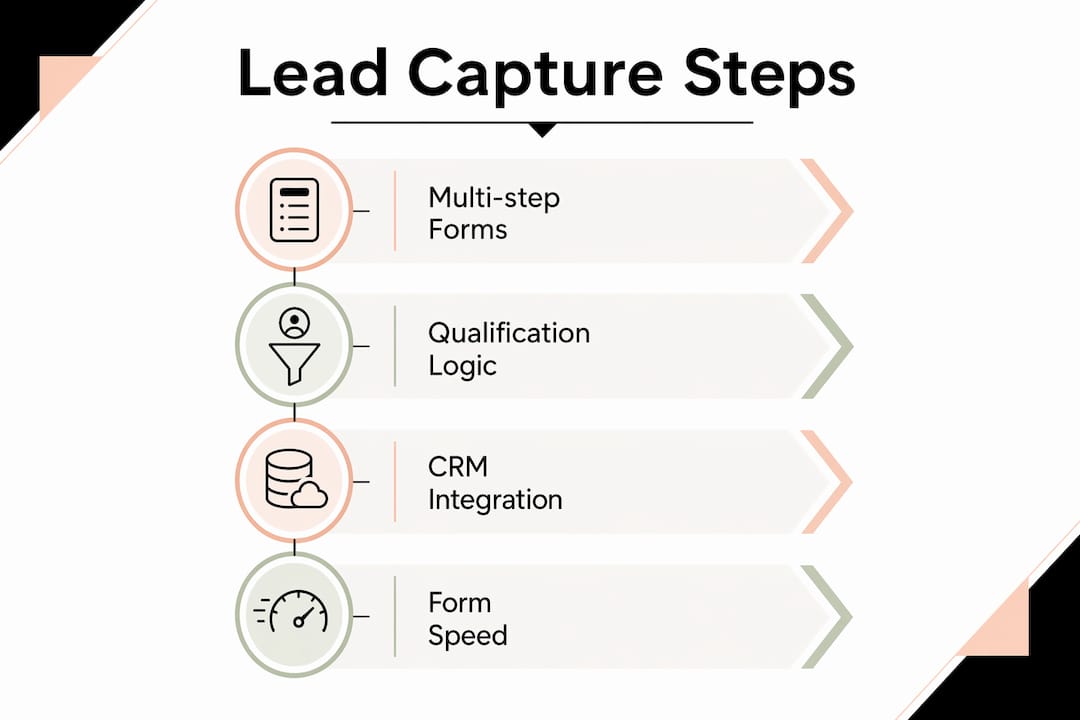
The backend infrastructure of a lead generation website has four interdependent layers. Each one must function correctly for the others to deliver results.
g1. Multi-step and conditional forms. Multi-step forms reduce overwhelm by presenting one question at a time, which increases completion rates compared to long single-page forms. Conditional logic means the form adapts based on previous answers, so a plumber asking about a boiler repair sees different follow-up questions than one asking about a new installation. This produces cleaner, more useful data for your sales team.
g2. Backend qualification logic. Once a form is submitted, the site’s backend should apply scoring rules automatically. A lead from a commercial property in London with a budget above £10,000 should be routed differently from a residential enquiry with no stated budget. The most crucial element in high-performing lead generation websites is this qualification logic, which determines lead quality and routes contacts through appropriate CRM pipelines.

g3. CRM and calendar integration. Fragmented systems cause revenue leakage. When a form submission lands in an email inbox rather than a CRM like Salesforce or a connected calendar, response times slow and leads go cold. Integration means the lead appears in the right pipeline, triggers a task for the sales team, and sends an automated reply to the prospect within seconds.
g4. Page speed and form responsiveness. A slow-loading form kills conversions before they start. Google’s Core Web Vitals data consistently shows that load time directly affects bounce rate, and a form that takes more than three seconds to appear will lose a measurable proportion of mobile users.
Pro Tip: Test your lead capture flow end to end at least once a month. Submit a test enquiry and time how long it takes to appear in your CRM, trigger an automated reply, and notify your team. Gaps in that chain are where leads disappear.
You can review how this kind of funnel architecture works in practice across different service business types.
How does AI-driven intent data improve lead quality?
The fundamental shift in 2026 is the move from interruption-based marketing to AI-driven personalised value exchanges. Rather than broadcasting the same message to every visitor, modern websites use behavioural signals to identify which visitors are actively researching a purchase and serve them content or offers that match their intent.
Marketers using automation tools see 77% higher lead conversion compared to non-automated methods. That figure reflects the compounding effect of reaching the right person with the right message at the right moment, rather than sending the same email sequence to every contact regardless of behaviour.
Traditional capture versus AI-integrated approaches
| Approach | Method | Outcome |
|---|---|---|
| Traditional form capture | Static form, manual follow-up | Slow response, low personalisation |
| AI-intent scoring | Behavioural tracking, predictive scoring | Prioritised outreach to warm leads |
| Automated nurture sequences | Triggered emails based on actions | Higher activation rates, less manual effort |
| Predictive analytics | Historical data models future behaviour | Improved pipeline predictability |
Top-performing B2B teams leverage AI-powered intent data to focus on accounts with the highest likelihood to convert, which improves pipeline predictability significantly. Tools like Leadfeeder and Clearbit track company-level visit data, so you know when a target account is browsing your pricing page before they ever fill in a form.
Pro Tip: Even without enterprise AI tools, you can replicate intent scoring manually. Tag contacts in your CRM based on which pages they visited, how long they spent on your services page, and whether they returned within seven days. Those three signals alone will identify your warmest leads.
Which design elements boost conversion on lead generation websites?
Conversion rate is the most direct measure of how well your website generates leads. Dedicated landing pages convert at an average rate of 6.6%, compared to 2 to 3% for general website pages. That gap exists because landing pages remove distractions, focus on a single offer, and align the headline with the specific search or advert that brought the visitor there.
Several design and content factors drive that performance gap:
- Single-focus calls to action. A page with one clear next step converts better than a page with five options. Every additional choice reduces the likelihood of any action being taken.
- Social proof placed near the CTA. Testimonials, case study summaries, and review scores positioned directly above or beside a form increase trust at the moment of decision. A builder’s website showing three verified Google reviews next to the quote request form will outperform the same page without them.
- Short-form video. A 60 to 90 second video showing your team, your process, or a completed project builds credibility faster than any block of text. Visitors who watch a video are significantly more likely to submit an enquiry.
- Minimal form fields. Every additional form field reduces completion rates. Ask only for what you need to qualify the lead and follow up. Name, contact detail, and one qualifying question is often sufficient for a first-touch capture.
- Mobile-first layout. The majority of service business enquiries now arrive via mobile. A form that requires pinching, zooming, or excessive scrolling will lose those visitors before they complete it.
For a detailed breakdown of how these principles apply across different website types, gtwelve’s guide to conversion-focused web design covers the practical implementation in depth.
What are the most effective lead nurturing strategies post-capture?
Capturing a lead is the beginning of the process, not the end. The majority of leads that do not convert immediately are simply not ready to buy yet. The businesses that win are those with a structured system for staying relevant until the prospect is ready.
g1. Segmented email nurture sequences. Email marketing delivers returns as high as 45:1 in retail and eCommerce sectors with well-designed nurture sequences. The key word is segmented. A sequence sent to a commercial property manager should differ entirely from one sent to a homeowner. Behavioural triggers, such as opening a specific email or revisiting the pricing page, should advance the contact to a more direct sales conversation automatically.
g2. Retargeting based on visit behaviour. A visitor who spent four minutes on your services page but did not enquire is a warm prospect. Retargeting ads on Google and Meta serve that visitor relevant content for the following 30 days, keeping your business visible while they continue their research. This is not about volume. It is about staying present for the right people.
g3. Social selling on LinkedIn. LinkedIn organic marketing delivers 229% ROI across industries, making it the highest-return social platform for B2B lead generation. For service businesses, this means connecting with decision-makers, sharing case studies, and commenting on relevant conversations rather than broadcasting promotional content. Relationship-building on LinkedIn shortens the sales cycle for high-value contracts.
g4. Lead scoring integrated with sales outreach. When your CRM assigns a score to each lead based on behaviour, your sales team knows exactly who to call first. A lead that has visited your site three times, opened four emails, and watched your case study video is far more likely to convert than one who submitted a form six weeks ago and has not engaged since. Prioritising outreach based on that data is one of the highest-leverage changes a service business can make. You can explore how automated follow-up workflows connect to your existing tools without rebuilding your entire process.
Key takeaways
Modern websites generate leads reliably only when frontend capture, backend qualification logic, and automated follow-up operate as a single connected system.
| Point | Details |
|---|---|
| Backend logic is the priority | Qualification, tagging, and CRM routing determine lead quality more than design alone. |
| AI intent data improves conversion | Automation tools produce 77% higher lead conversion by targeting high-intent prospects. |
| Landing pages outperform general pages | Dedicated pages convert at 6.6% versus 2 to 3% for standard website pages. |
| Form length directly affects completion | Removing unnecessary fields increases submission rates; ask only what you need to qualify. |
| Nurturing converts delayed decisions | Segmented email sequences and retargeting keep warm leads engaged until they are ready to buy. |
Why your website is revenue infrastructure, not a marketing brochure
I have worked with enough service businesses to say this plainly: the single most common mistake is treating a website as something you build once and leave. The businesses that generate consistent leads from their websites treat them the way a manufacturer treats a production line. They monitor throughput, identify where contacts drop off, and fix the constraint.
The second most common mistake is over-engineering the front end while ignoring the back end. I have seen beautifully designed websites where the form submission goes to a generic email inbox, nobody responds within 24 hours, and the lead books with a competitor. The design was excellent. The system was broken.
What I find genuinely interesting about 2026 is that the tools required to build a proper lead generation system are now accessible to small businesses. You do not need an enterprise budget to connect a form to a CRM, trigger an automated reply, and score leads based on behaviour. The barrier is not cost. It is knowing what to build and in what order.
My honest recommendation: start with the follow-up. Before you redesign your website or invest in paid traffic, fix what happens after someone enquires. A fast, personalised, automated response to every enquiry will produce more revenue than any design refresh. Once that system works, then optimise the front end to send more leads into it. The importance of timely follow-up is something most businesses underestimate until they see the data.
— Ben
Build a website that works as hard as you do
If this article has clarified what your website should be doing and you are not sure where to start, gtwelve builds conversion-focused websites for UK service businesses with the full system included. That means structured lead capture, CRM integration, automated follow-up, and ongoing reporting, not just a good-looking site.

We work with trades, local service providers, and SMEs who want better enquiries and less manual admin. Every project connects your website to your existing workflows, whether that is Microsoft 365, a calendar system, or a quote process. If you want to see what a properly integrated lead generation website looks like for your type of business, get in touch with gtwelve directly at gtwelve.co.uk.
FAQ
What are website leads?
Website leads are contacts who have submitted their information through your site, indicating interest in your product or service. They become qualified leads when backend logic confirms they meet your criteria for follow-up.
How do I boost website leads without more traffic?
Improving your form design, reducing field count, adding social proof near your CTA, and fixing your follow-up speed will increase leads from your existing traffic. Dedicated landing pages converting at 6.6% versus 2 to 3% for general pages show how much conversion improvement is possible without changing your traffic volume.
What is the role of CRM integration in lead generation?
CRM integration ensures every form submission is captured, scored, and routed to the right person automatically. Without it, leads sit in email inboxes, response times slow, and warm prospects book with competitors.
How does AI improve lead generation on a website?
AI-powered intent tracking identifies which visitors are actively researching a purchase based on behavioural signals, allowing you to prioritise outreach and personalise follow-up. Businesses using automation tools see 77% higher lead conversion as a result.
Why do most leads fail to convert?
80% of new leads never convert to sales, primarily because businesses lack structured qualification and follow-up systems. Most unconverted leads are not bad leads. They are simply not ready to buy at the moment of first contact and receive no further communication.
Recommended
If this sounds like your website, we can take a look.
Note 44 of 72