Why AI visibility differs from SEO: a 2026 guide
16 July 2026 · 3 min read
Why AI visibility differs from SEO: a 2026 guide

AI visibility is defined as the measure of how frequently AI systems cite your content in generated answers, and it operates on entirely different rules from traditional SEO. Where SEO targets ranked positions in a link list, AI visibility determines whether a large language model like Google AI Overview or Perplexity selects your content as a source when assembling a synthesised response. The distinction matters because informational query traffic has declined 20–40% since AI responses began intercepting searches that once sent users to your site. That shift means ranking on page one no longer guarantees visibility. Understanding why AI visibility differs from SEO is the first step to adapting your content strategy for both.
Why AI visibility differs from SEO in how engines process content
Traditional search engines produce a ranked list of links. AI engines produce a single synthesised answer, and that difference changes everything about how your content needs to be written and structured.
A traditional search engine crawls pages, scores them using signals like backlinks, keyword relevance, and page authority, then returns a ranked list. The user clicks through to your site. An AI engine does something fundamentally different. It reads across multiple sources, extracts the most relevant facts, and assembles a coherent answer. Your site may never receive a click, yet your content could be cited as the source.

AI engines prioritise extraction, entity clarity, and concise attribution over the ranking signals that SEO depends on. This means a page that ranks third for a keyword could be cited far more often than the page in first position, simply because it states facts more clearly. The citation graph replaces the link graph as the primary measure of authority.
AI visibility depends more on third-party mentions than on hyperlinking, which is a direct reversal of how SEO link authority works. A brand mentioned consistently across news articles, directories, and industry publications builds AI citation authority even without a single backlink pointing to its domain.
| Signal type | Traditional SEO | AI visibility |
|---|---|---|
| Authority measure | Backlinks and domain rating | Third-party brand mentions and citations |
| Content preference | Keyword-optimised prose | Structured, atomised facts with clear entity signals |
| Schema use | Rich snippets and meta data | JSON-LD with specific types: FinancialService, Person, Organization |
| Freshness weighting | Moderate, age can build authority | High, recent content earns more citations |
| Success metric | Rankings and click-through rate | Citation frequency and brand mention volume |
Pro Tip: Check whether your most important pages use specific Schema.org types such as Organization or FAQPage. Generic schema gives AI systems far less to work with than typed, relationship-mapped markup.
What content practices improve AI visibility but differ from traditional SEO?
AI systems prefer content that states facts directly and without narrative burying. Narrative burying means hiding key information inside long paragraphs of prose, and it is one of the most common reasons well-ranked pages remain invisible to AI search engines. An AI synthesis engine cannot easily extract a fact buried in the middle of a 400-word introduction.
Freshness carries more weight for AI citation than it does for traditional SEO rankings. Content updated within the last two months receives significantly higher AI citation rates than older static content. For SEO, an aged, authoritative page can hold its ranking for years. For AI visibility, that same page may be passed over in favour of a recently updated competitor.
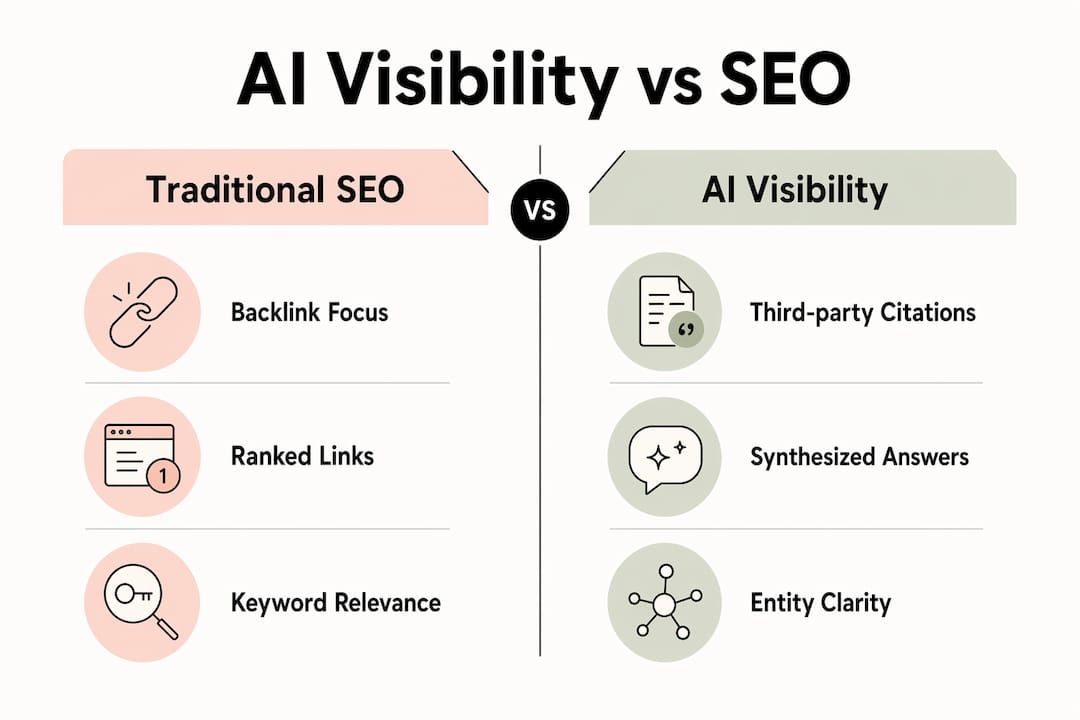
Structured schemas like FinancialService, Person, and Organization give AI systems machine-readable context about who you are and what you do. Well-implemented JSON-LD schema markup improves citation likelihood because it removes ambiguity about your entity type. Traditional SEO uses schema primarily for rich snippets in search results, which is a narrower application.
FAQ schema is a useful example of where the two disciplines diverge. FAQ schema helps SEO by generating expandable results in Google Search. For AI visibility, however, a long FAQ section can actually dilute the clarity of your core entity signals if the questions are vague or the answers are padded. AI systems prefer direct, unambiguous answers over a list of loosely related questions.
AI visibility tactics versus traditional SEO tactics:
- Write one clear answer per heading, not a paragraph that eventually gets to the point
- Update key pages at least every two months to maintain citation eligibility
- Use specific Schema.org types rather than generic WebPage markup
- Build third-party mentions through press, directories, and industry publications
- State your business category, location, and service clearly in the first 50 words of every page
- For SEO: focus on keyword placement, internal linking, and backlink acquisition
- For AI: focus on entity clarity, structured data, and evidence-based external citations
Pro Tip: Treat each page section as a standalone fact unit. If an AI system extracted only that section, would it still make sense and correctly identify your brand? If not, rewrite it.
Why do AI visibility metrics diverge from traditional SEO metrics?
The most striking difference between AI visibility and SEO metrics is the decoupling of impressions from clicks. One page received over 30,000 impressions from AI-generated answers but zero clicks over 90 days. That is not a tracking error. It reflects how AI answers work: the user gets the information without visiting the source.
“AI visibility is a leading indicator of brand familiarity and authority rather than a direct traffic driver. Measuring it with click-based metrics alone will always make it look like it is failing, when it is actually doing exactly what it is designed to do.”
This reframing matters for how you report results to stakeholders. A marketer measuring AI visibility with a traffic dashboard will see declining numbers and draw the wrong conclusion. The correct metrics for AI visibility are citation frequency, brand mention volume across AI platforms, and share of voice within AI-generated answers for your core topics.
Third-party, evidence-based citations are approximately 6.5 times more effective for AI visibility than self-citations. That figure has a direct implication for content strategy: publishing authoritative content on your own site is necessary but not sufficient. You need external sources, journalists, and industry bodies to reference your brand by name.
| Metric | Traditional SEO | AI visibility |
|---|---|---|
| Primary success signal | Organic click-through rate | Citation frequency in AI answers |
| Traffic expectation | Direct visits from ranked results | Low or zero direct clicks |
| Brand authority signal | Domain rating and backlink count | Third-party mention volume |
| Measurement tool | Google Search Console | AI citation tracking across platforms |
| Funnel position | Mid to bottom funnel | Top of funnel, brand awareness |
AI visibility is a multi-platform metric, meaning you need to track citation rates across Google AI Overview, Perplexity, and other AI search systems separately. Each platform interprets content differently, so a brand cited frequently in one system may be absent from another.
How to integrate AI visibility with your existing SEO strategy
The good news is that Google’s generative AI features are rooted in core SEO ranking systems, so strong SEO fundamentals still matter. You do not need to abandon your existing strategy. You need to extend it.
A practical integration approach works in five steps:
- Audit your technical foundation. Confirm your sitemap is current, your pages are indexed, and your crawl coverage is complete. AI systems cannot cite pages they cannot access.
- Add specific schema markup. Move beyond generic WebPage schema. Implement Organization, LocalBusiness, Person, or FinancialService types with full relationship mapping using JSON-LD.
- Rewrite for entity clarity. Review your top 10 pages. Each one should state your business name, category, location, and primary service within the first paragraph. Remove narrative burying.
- Build third-party citations. Pursue mentions in trade publications, local directories, and industry bodies. A mention without a link still builds AI authority. Aim for sources that AI systems already cite frequently in your sector.
- Update content on a regular cycle. Set a two-month review cadence for your highest-priority pages. Refresh statistics, update service details, and add new examples to maintain citation eligibility.
For AI-ready content structure, the principle is simple: write for extraction, not just for reading. A human reader tolerates a slow build-up. An AI synthesis engine does not.
Pro Tip: Run a search for your brand name in Perplexity and Google AI Overview. Note which pages get cited and which do not. The cited pages share common traits: clear entity signals, recent updates, and specific schema. Apply those traits to your uncited pages.
Tracking both SEO and AI visibility requires separate dashboards. Google Search Console covers traditional rankings and clicks. AI citation tracking requires dedicated tools or manual monitoring across platforms. The trade business visibility checklist from gtwelve covers both dimensions for UK service businesses.
Key takeaways
AI visibility and traditional SEO require distinct strategies because AI engines synthesise answers rather than rank links, making citation frequency the primary success metric rather than click-through rate.
| Point | Details |
|---|---|
| Different engines, different signals | AI engines need entity clarity and structured data; SEO needs backlinks and keyword relevance. |
| Freshness drives AI citations | Update key pages every two months to stay eligible for AI citation. |
| Third-party mentions outperform self-citation | External brand mentions are 6.5 times more effective than self-citations for AI visibility. |
| Zero-click is not failure | High AI impressions with low clicks indicate top-of-funnel brand awareness, not poor performance. |
| SEO fundamentals still apply | Strong technical SEO remains the foundation; AI visibility extends it with entity and schema work. |
The uncomfortable truth about AI visibility that most guides miss
I have worked with enough UK service businesses to see the same mistake repeated. A business owner checks their Google Analytics, sees traffic dropping, and concludes their SEO is broken. In many cases, their SEO is fine. Their content is being cited in AI answers, delivering brand impressions to thousands of people who never click through. The problem is not the strategy. The problem is the measurement.
What I find genuinely interesting about AI visibility is that it rewards the businesses that have always done the right things: clear writing, authoritative external mentions, and a well-defined brand identity. The businesses that relied on keyword stuffing and low-quality link schemes are the ones struggling most with AI citation.
The multi-platform nature of AI visibility is the part most guides underplay. Google AI Overview, Perplexity, and other systems each have their own citation logic. A brand that appears consistently across all of them has built something closer to genuine authority than a brand that ranks first for a single keyword. That is a harder thing to manufacture, and that is precisely why it is worth pursuing.
My honest recommendation is to treat AI visibility as a brand-building metric for the next 12 months. Do not expect it to replace your SEO traffic. Do expect it to show up in client recognition, inbound enquiry quality, and the frequency with which prospects say they have already heard of you before making contact. Those are the signals that matter, and they are harder to fake than a page-one ranking.
— Ben
How gtwelve helps you rank in both search and AI answers
gtwelve works with UK service businesses to build online presence that performs across both traditional search and AI-powered platforms.
The approach covers technical SEO, entity-mapped schema, content structure built for AI extraction, and third-party citation building. If your traffic has shifted but your enquiries have not, or if you want to understand where your brand currently appears in AI-generated answers, gtwelve can audit both dimensions and build a plan that addresses them together. Visit gtwelve.co.uk to find out how we help service businesses appear in the right places, whether that is a Google ranking or an AI-generated answer.
FAQ
What is AI visibility in SEO terms?
AI visibility measures how often AI systems cite your content in generated answers. It differs from traditional SEO, which measures rankings and click-through rates.
Does good SEO automatically improve AI visibility?
Strong technical SEO helps, but AI visibility also requires clear entity signals, specific schema markup, and third-party brand mentions that SEO alone does not address.
Why has my organic traffic dropped despite good rankings?
Informational query traffic has declined 20–40% as AI-generated answers intercept searches before users click through to websites. Your rankings may be intact while AI answers absorb the traffic.
How do I measure AI visibility for my business?
Track citation frequency across Google AI Overview and Perplexity separately, monitor third-party brand mention volume, and review which pages appear as sources in AI-generated answers for your core topics.
Is AI visibility more important than SEO in 2026?
AI visibility and SEO are complementary, not competing. Google’s generative AI features remain rooted in core SEO systems, so strong SEO fundamentals underpin both objectives.
Recommended
If this sounds like your website, we can take a look.
Note 08 of 72