Why slow websites lose customers (and cost you sales)
18 July 2026 · 3 min read
Why slow websites lose customers (and cost you sales)

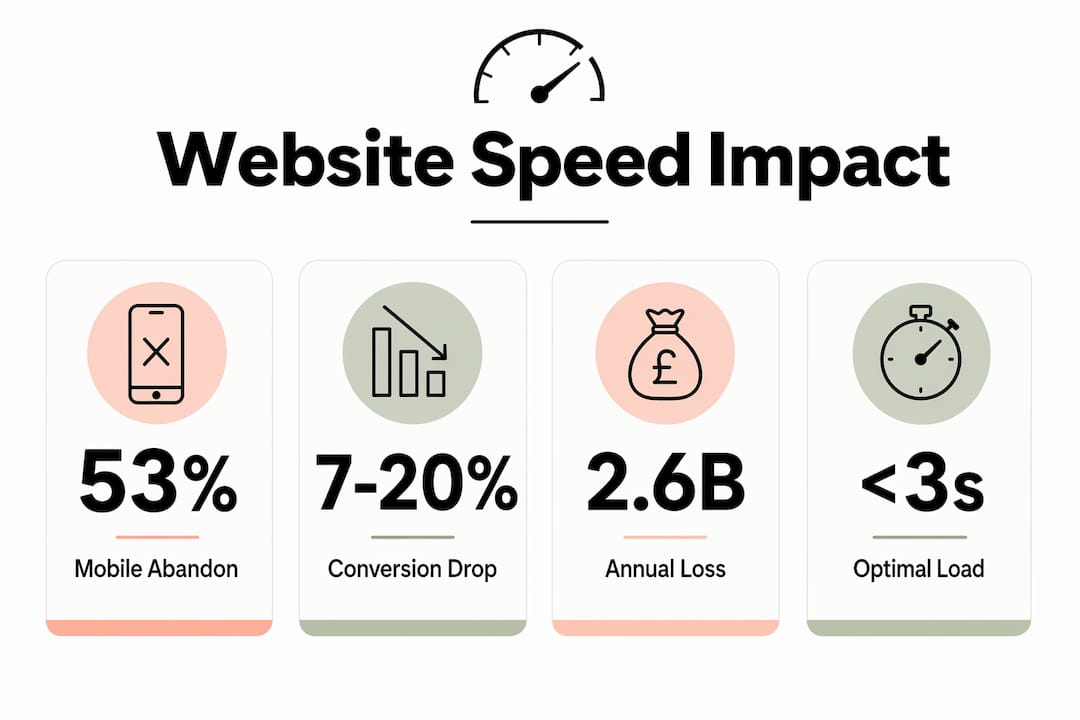
Slow websites lose customers because every second of delay reduces the chance a visitor stays, enquires, or buys. 53% of mobile users abandon a site that takes more than three seconds to load. That single figure represents real enquiries, real sales, and real revenue walking away before you even know they arrived. For UK service businesses and SMEs, the impact of slow websites is not a technical inconvenience. It is a direct threat to growth.
Why slow websites lose customers: the data behind the drop
Website loading speed is the single biggest factor in whether a visitor stays or leaves. The evidence is unambiguous and the numbers are large enough to demand attention.
53% of mobile users abandon a site that takes more than three seconds to load, and conversion rates fall by 7%–20% for every additional second of delay. A two-second delay alone can push cart abandonment to 87%. Sites that load in under two seconds achieve 2.4 times higher conversion rates than those taking over five seconds. These are not marginal differences. They represent the gap between a business that generates enquiries online and one that does not.

The website loading time effects extend beyond the checkout. Slow website speed increases bounce rates, shortens session durations, and reduces form completions. A visitor who leaves after five seconds never fills in your contact form, never reads your service page, and never becomes a lead. The damage runs through every stage of your conversion funnel.
Core Web Vitals are Google’s framework for measuring user-centric performance. The three key thresholds are:
- Largest Contentful Paint (LCP): the main content should load within 2.5 seconds
- Interaction to Next Paint (INP): the site should respond to user input within 200 milliseconds
- Cumulative Layout Shift (CLS): visual stability should score below 0.1
Google uses page speed as a direct ranking factor, meaning a slow site loses organic search visibility as well as visitor retention. Failing Core Web Vitals pushes your site down the results page, reducing the number of visitors who find you in the first place.
Pro Tip: Run your site through Google PageSpeed Insights today. It gives you a free Core Web Vitals score and flags the specific issues dragging your load time down.
What causes a slow website?
Most slow websites share the same handful of technical problems. Understanding them helps you prioritise where to act first.
Common causes of website slowness include unoptimised images, render-blocking scripts, slow server response times, the absence of a Content Delivery Network (CDN), and excessive HTTP requests. Each issue adds latency individually. When several exist together, they compound. A page that takes 1.5 seconds to load with one problem can take 4 or 5 seconds when three problems stack up.
Here is what each cause means in plain terms:
- Unoptimised images: Large image files are the most common culprit. A single uncompressed photograph can add one to two seconds to load time on its own.
- Render-blocking scripts: JavaScript and CSS files that load before the page content force the browser to wait. The visitor sees a blank or incomplete screen.
- Slow server response (TTFB): Time to First Byte measures how long the server takes to respond. A slow hosting provider or an overloaded server adds delay before any content loads at all.
- No CDN: A Content Delivery Network stores copies of your site on servers around the world. Without one, every visitor loads your site from a single location. CDNs can improve load speed by 15%–30%.
- Excessive HTTP requests: Every element on a page, including fonts, scripts, and tracking pixels, requires a separate server request. Too many requests slow the entire page down.
Pro Tip: Compress all images before uploading using a tool like Squoosh or TinyPNG. This single step often cuts page weight by 40%–60% with no visible quality loss.
Performance optimisation is not a one-off task. It requires ongoing monitoring, testing, and incremental improvements as your site grows and changes.
How a slow website damages your brand reputation
The financial cost of slow loading is measurable. The reputational cost is harder to quantify but equally serious.
Users subconsciously associate slow websites with low quality and a lack of professional competence. This is the halo effect in action. A visitor who waits four seconds for your page to load does not think “their server is under load.” They think “this business is not on top of things.” That impression sticks, and it affects whether they trust you with their money.
“Responsiveness is now a brand value signal. A slow site does not just frustrate visitors. It tells them something about how you run your business. In 2026, customers expect near-instant digital interactions in every sector. When your site fails that expectation, they draw conclusions about your reliability, your attention to detail, and your professionalism.”
Consumer expectations in 2026 treat speed as a core brand attribute. Fast, accurate, personalised digital responses shape customer loyalty more than ever. A slow site signals operational weakness and accelerates churn. Customers who leave rarely complain. They simply do not return.
Companies that prioritise responsiveness build stronger long-term loyalty. The inverse is equally true. Slow responses, whether from a support team or a web server, create frustration that compounds into lost sales and lasting reputational damage. For a trades business or local service provider, where reputation drives referrals, this matters enormously.
The connection between website design and perceived trust is well established. Speed is part of that design. A site that loads quickly signals that the business behind it is organised, professional, and worth engaging with.
Pro Tip: Ask a friend or colleague to visit your website on a mobile device using 4G, not Wi-Fi. Their honest reaction tells you more than any analytics report.
Practical steps to improve your website speed
Improving site speed does not require a full rebuild. Most businesses can make significant gains by addressing a short list of high-impact issues.
-
Run a performance audit. Use Google PageSpeed Insights or GTmetrix to get a baseline score. Both tools identify specific problems and rank them by impact. Do this before making any changes so you can measure progress.
-
Compress and resize images. Images are the most common cause of slow load times. Resize images to the dimensions they actually display at, and compress them using a tool like Squoosh. Use modern formats such as WebP where your platform supports them.
-
Reduce render-blocking resources. Work with your developer to defer non-critical JavaScript and load CSS asynchronously. This allows the visible content to appear faster, even if background scripts are still loading.
-
Enable browser caching and server-side caching. Caching stores a version of your page so repeat visitors load it faster. Most hosting platforms and content management systems support this through a plugin or server setting.
-
Use a Content Delivery Network. A CDN distributes your site’s files across multiple servers globally. UK visitors load from a UK server, reducing the physical distance data must travel. This is particularly effective for image-heavy service pages.
-
Improve your hosting. Shared hosting plans are inexpensive but often slow. Moving to a managed hosting provider with solid-state drives and dedicated resources can cut server response time significantly.
-
Monitor Core Web Vitals regularly. Google Search Console shows your Core Web Vitals scores over time. Set a monthly reminder to check them. Improving your conversion rate depends on maintaining performance as your site evolves, not just fixing it once.
Retail businesses lose approximately £2.6 billion annually to slow website performance, with 76% of customers abandoning carts due to loading issues. For a local service business, the numbers are smaller but the proportion of lost revenue is just as damaging. A single missed enquiry from a high-value job can cost more than a year of hosting fees.
Speed is the metric most business owners ignore
Speed is the metric most business owners ignore, and it is the one costing them the most.
I have spoken with dozens of trades and service businesses who had no idea their website was slow. They had invested in a good-looking site, written decent content, and were running Google Ads. But their conversion rate was poor and they could not work out why. In almost every case, the site was taking five or six seconds to load on mobile. Every paid click was landing on a page that drove visitors away before they read a single word.
The silent drain of slow websites is the hardest problem to diagnose because customers do not tell you they left. There is no complaint, no email, no negative review. The analytics just show a high bounce rate and short sessions, and most business owners do not connect that to load time.
Speed and design are not separate concerns. A fast, well-designed site signals competence. It tells visitors that you take your business seriously. For SMEs building their online presence in 2026, speed is not a technical detail to hand off to a developer. It is a core business metric, as important as your response time to enquiries or the quality of your quotes.
My honest advice: treat your website speed score the same way you treat your Google rating. Check it regularly, act on it when it drops, and never assume it is fine just because the site looks good.
— Ben
How gtwelve helps you stop losing customers to a slow site
A slow website is a business problem, not just a technical one. gtwelve builds conversion-focused websites for UK service businesses and SMEs that are fast by design, not as an afterthought.

Every site gtwelve builds is tested against Core Web Vitals thresholds, optimised for mobile load times, and hosted on infrastructure that supports fast server response. Performance audits are part of the process, not an optional extra. If your current site is losing enquiries due to speed, gtwelve can identify exactly where the problem lies and fix it. Get in touch to find out what your site is currently costing you.
FAQ
How much does a slow website affect conversion rates?
Every 100 milliseconds of added delay reduces conversion rates by 7%, and a one-second delay can reduce conversions by up to 22%. Sites loading in under two seconds convert at 2.4 times the rate of those taking over five seconds.
What is a good website load time in 2026?
Google’s Core Web Vitals standard sets Largest Contentful Paint at under 2.5 seconds as the target. Practically, any page taking more than three seconds to load on mobile risks losing more than half its visitors before they engage.
Why do slow websites hurt SEO rankings?
Google has used page speed as a ranking factor since 2018, and Core Web Vitals failures directly lower your position in search results. A slower site receives less organic traffic, compounding the revenue loss from poor on-site conversion.
What is the most common cause of a slow website?
Unoptimised images are the most frequent cause of slow load times, often combined with render-blocking scripts and slow server response. Addressing images alone typically produces the fastest and most noticeable improvement.
How do I know if my website is too slow?
Run your URL through Google PageSpeed Insights, which is free and gives you a Core Web Vitals score alongside specific recommendations. You can also check common enquiry drop-off causes to understand whether speed is affecting your lead generation.
Key takeaways
Slow websites lose customers at every stage of the funnel, from the first page load to the final enquiry, and the damage compounds across conversion rates, search rankings, and brand perception.
| Point | Details |
|---|---|
| Speed drives conversion | Sites loading under two seconds convert at 2.4 times the rate of those taking over five seconds. |
| Every second costs money | A one-second delay reduces conversions by up to 22%, directly cutting enquiries and sales. |
| Brand trust suffers silently | Visitors associate slow sites with poor professionalism and rarely return or complain. |
| Core Web Vitals affect rankings | Failing Google’s LCP, INP, and CLS thresholds lowers your search position and reduces organic traffic. |
| Optimisation is ongoing | Performance requires regular audits, image compression, caching, and CDN use, not a single fix. |
Recommended
If this sounds like your website, we can take a look.
Note 06 of 72