Why website design affects trust: a business guide
15 June 2026 · 3 min read
Why website design affects trust: a business guide

Website design is the primary driver of perceived credibility online, with 75% of consumers judging a business’s trustworthiness based on its website’s visual design alone. That judgement happens before a single word is read. The field of web credibility research, pioneered by Stanford’s Web Credibility Project, confirms that visual quality and user experience shape trust faster than any written claim. For business owners and marketers, understanding why website design affects trust is not a branding exercise. It is a direct commercial priority.
Why website design affects trust at a psychological level
The mechanism behind design and trust is the halo effect. When a visitor lands on a well-designed page, their brain extends that positive impression to assume competence, reliability, and professionalism across the entire business. The reverse is equally powerful. A poor first impression triggers confirmation bias, causing visitors to actively seek out further evidence of untrustworthiness.
The speed of this process is remarkable. The human brain processes visuals 60,000 times faster than text, which means your layout, colour palette, and spacing communicate before your copy does. A clean layout signals professionalism in under a second. A cluttered or dated one creates doubt in the same timeframe.
“Design functions like a brand’s clothes in a job interview. Neat, consistent design communicates reliability and care before a single word is spoken.” — The Design Inspiration
Confirmation bias compounds the problem significantly. Once a visitor decides a site looks untrustworthy, they will interpret every subsequent element through that lens. A slow page load becomes proof of neglect. A missing phone number becomes evidence of a scam. Reversing that initial judgement is almost impossible, which is why the first visual impression carries such disproportionate weight.
Which design elements most influence credibility?
Visual aesthetics, functionality, and brand consistency are the three pillars of trustworthiness in website design. Each operates differently, but all three must work together.

Visual aesthetics and professionalism
Professional photography, a coherent colour palette, and generous white space signal that a business takes itself seriously. Luxury brands use wider spacing deliberately to communicate confidence and reliability. Tight, cramped layouts and misaligned typography produce a subtle discomfort that visitors cannot always name but always feel. That discomfort translates directly into distrust.
Functionality and user experience
Navigation that works, links that load, and pages that respond quickly are non-negotiable trust signals. Website design, ease of use, and subjective norms directly influence brand trust, mediated by how useful visitors perceive the experience to be. A broken link or a form that fails to submit tells a visitor that the business does not maintain its own tools. That inference extends to how they imagine the business would treat them as a client.
Brand consistency across every page
Consistent colour, typography, and spacing across all pages reinforces familiarity and builds what neuroscientists call a predictability loop. When every page feels like it belongs to the same brand, the brain registers safety. When pages feel mismatched, a neural warning pathway fires. Visitors rarely articulate this reaction. They simply leave.
| Design Element | Trust Signal | Distrust Signal |
|---|---|---|
| Colour palette | Consistent, on-brand colours throughout | Clashing or inconsistent colours between pages |
| Typography | Clear hierarchy, readable fonts, even spacing | Mixed fonts, cramped text, poor alignment |
| Photography | Professional, relevant, high resolution | Stock photos that feel generic or low quality |
| Navigation | Logical structure, working links, fast load | Broken links, confusing menus, slow response |
| Trust badges | SSL certificate, payment icons, accreditations | No security indicators, missing contact details |
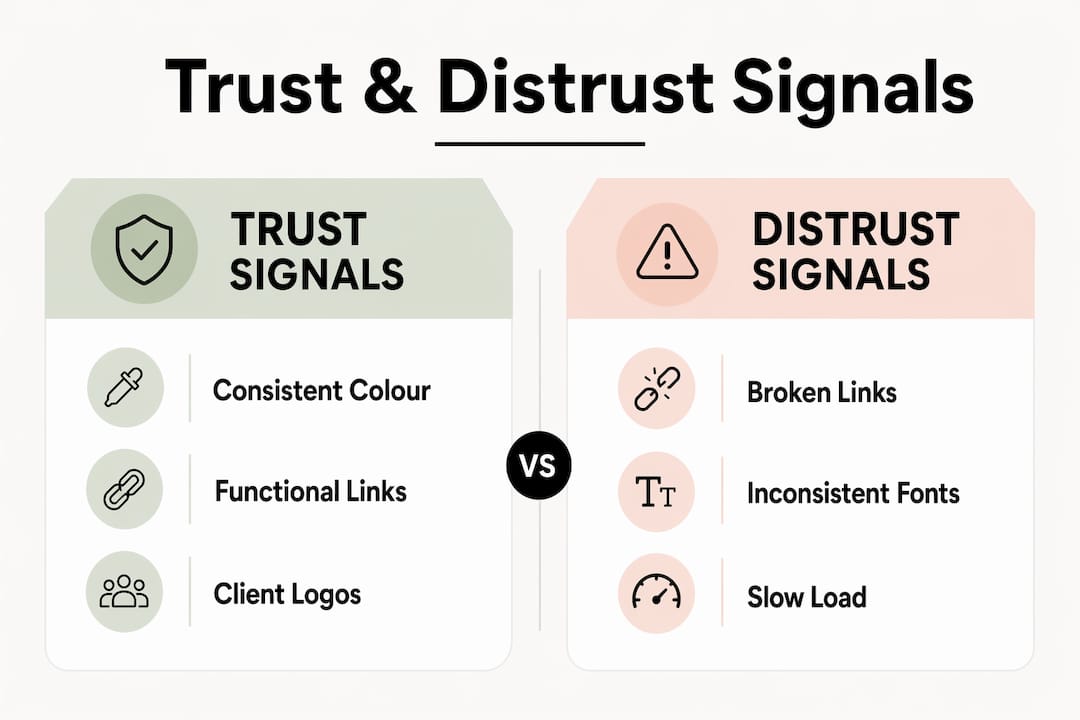
Pro Tip: Check your site on a mobile device you have never used before. Spacing and alignment issues that are invisible on your own screen become obvious on an unfamiliar device, and mobile visitors are often the first to abandon a site that feels off.
How poor design damages business outcomes
Poor website design does not just look bad. It costs you enquiries, clients, and revenue. Websites that build trust see visitors spend three times longer on pages, are 2.4 times more likely to initiate contact, and are five times more likely to advocate for the brand. The inverse of those numbers describes what poor design delivers.
65% of shoppers distrust websites featuring poor grammar or broken links. That distrust is immediate and largely irreversible. A single broken link or a typo in a headline can undo months of marketing spend by confirming a visitor’s worst suspicions about your professionalism.
Common design pitfalls that actively harm trust include:
- Broken links and 404 errors that signal neglect and poor maintenance
- Grammatical errors and inconsistent copy that undermine perceived expertise
- Missing or outdated contact information that raises questions about legitimacy
- No SSL certificate (the padlock icon) that browsers now flag as a security risk
- Slow page load times that frustrate visitors and increase bounce rates
- Inconsistent branding across pages that creates a disjointed, unprofessional feel
- Generic or low-quality imagery that fails to differentiate the business from competitors
Each of these issues compounds the others. A visitor who notices one problem will look for more. Confirmation bias means they will find them, even if the rest of the site is well built. The result is a high bounce rate, low enquiry volume, and a brand reputation that underperforms relative to the actual quality of your service. Understanding where enquiries disappear from a website often starts with these exact design failures.
How to apply design principles to build trust and win enquiries
Building trust through design is a structured process, not a one-off redesign. Follow these steps to audit and improve your site’s credibility signals.
g1. Conduct a trust audit. Open your website on a device you do not normally use and ask yourself whether it looks like a business you would pay money to. Check every page for broken links, missing images, and inconsistent fonts. Tools like Google Search Console flag crawl errors and broken links automatically.
g2. Add visible trust signals. Trust signals such as testimonials, client logos, certifications, and secure payment badges operate without words. They communicate credibility to visitors who have not yet read a single sentence of your copy. Place them above the fold on your homepage and on every key landing page.
g3. Standardise your brand elements. Create a simple brand guide that specifies your exact colour codes, font choices, and spacing rules. Apply it consistently across every page, every social profile, and every document you send to clients. Brand consistency builds the predictability loop that neurological trust formation depends on.
g4. Prioritise page speed and mobile performance. Google PageSpeed Insights gives you a free, specific report on what is slowing your site down. Aim for a load time under three seconds on mobile. Slow sites lose visitors before the design even has a chance to make an impression.
g5. Proof every word on the site. Run your copy through Grammarly or a similar tool before publishing. A single grammatical error on a homepage can trigger the same distrust response as a broken link. Professional copy signals that you apply the same care to your work as you do to your website.
Pro Tip: Ask three people outside your industry to spend 30 seconds on your homepage and then describe what your business does. If they cannot answer accurately, your design is not communicating clearly enough, regardless of how good it looks.
Businesses that invest in conversion-focused web design consistently report higher enquiry rates because every design decision is made with the visitor’s trust journey in mind, not just aesthetics. Understanding how modern websites generate leads requires treating trust as a design output, not an afterthought.
Key takeaways
Website design is the single most powerful trust signal a business controls online, and every visual decision either builds or erodes visitor confidence.
| Point | Details |
|---|---|
| First impressions are visual | The brain processes design 60,000 times faster than text, making layout the first trust signal visitors encounter. |
| Halo effect drives credibility | A well-designed site leads visitors to assume competence and reliability across the whole business. |
| Consistency creates trust | Matching colour, typography, and spacing across all pages builds the predictability loop that trust depends on. |
| Poor design costs enquiries | Broken links and grammar errors cause 65% of shoppers to distrust a site immediately and irreversibly. |
| Trust signals work without words | Testimonials, client logos, SSL certificates, and accreditation badges communicate credibility before copy is read. |
The part most businesses get wrong about design and trust
I have reviewed hundreds of SME websites over the years, and the most common mistake is treating design as a one-time project rather than an ongoing signal of how the business operates. A business owner will invest in a new website, feel satisfied for six months, and then let it drift. Links break. Photography goes stale. The blog section sits empty with a post from 2022. Visitors notice all of it.
The second mistake is confusing aesthetics with trust. A beautiful website that loads slowly, has no testimonials, and buries the phone number in the footer does not build trust. It creates a gap between expectation and experience that is actually more damaging than a plain site that works perfectly. Visitors feel misled by polish that does not deliver substance.
What I have seen work consistently is treating the website as a live business tool rather than a brochure. That means regular content updates, working systems behind the contact forms, and visible proof of real client relationships. The businesses that invest in professional websites and maintain them properly generate enquiries at a measurably higher rate than those who treat design as a sunk cost.
The future of trust in web design will involve personalisation and AI-driven content adaptation, but the fundamentals will not change. Visitors will always judge you on what they see first. The businesses that take that seriously in 2026 will have a clear advantage over those that do not.
— Ben
Build a website that earns trust from the first click
If your website is not generating the enquiries your business deserves, the design is likely working against you rather than for you. gtwelve builds premium, conversion-focused websites for UK service businesses and SMEs, combining professional design with the trust signals, SEO visibility, and enquiry systems that turn visitors into clients.
Every site gtwelve builds is designed to communicate credibility from the first second, with consistent branding, visible trust signals, fast load times, and copy that converts. If you want a website that works as hard as you do, visit gtwelve to find out how we can help your business look and perform at its best.
FAQ
Why does website design affect trust so quickly?
The human brain processes visual information 60,000 times faster than text, meaning layout and colour communicate credibility before a visitor reads a single word. First impressions form in under a second and are very difficult to reverse.
What are the most important trust signals in web design?
Testimonials, client logos, SSL certificates, professional photography, and visible contact details are the most effective trust signals. They communicate credibility without requiring visitors to read detailed copy.
How does poor grammar affect website credibility?
65% of shoppers distrust websites that feature poor grammar or broken links, according to research by Clutch. Grammatical errors signal low professionalism and trigger confirmation bias, causing visitors to look for further evidence of untrustworthiness.
Does website layout build trust on its own?
Layout contributes significantly, but trust requires consistency across aesthetics, functionality, and brand elements. A visually clean layout that loads slowly or has broken links will still damage credibility despite its appearance.
How often should a business update its website design?
A full redesign every three to four years is a reasonable baseline, but trust signals such as testimonials, photography, and content should be reviewed and updated at least every six months to maintain credibility with returning visitors.
Recommended
If this sounds like your website, we can take a look.
Note 39 of 72