Why website URL structure matters for SEO
4 June 2026 · 3 min read
Why website URL structure matters for SEO

Website URL structure is the system by which a site’s addresses are organised to communicate page hierarchy, content type, and relevance to both search engines and users. Google, Moz, and Ahrefs all treat URL structure as a foundational technical SEO signal, not an afterthought. Get it right and your pages are easier to crawl, easier to trust, and more likely to rank. Get it wrong and you risk wasted crawl budget, confused visitors, and authority that never consolidates where it should.
Why website URL structure matters for crawlability and indexing
Search engines do not read your website the way a human does. Googlebot parses each URL as a sequence of path segments, using those segments to infer site hierarchy and relationships between pages. A URL like "/services/plumbing/emergency-repairs` tells the crawler that emergency repairs is a subcategory of plumbing, which sits under services. That logical chain reduces ambiguity and helps Google index the right pages for the right queries.
The opposite is also true. URLs loaded with session tokens, tracking parameters, or arbitrary ID numbers give crawlers almost no useful information. Complex parameter-heavy URLs can cause Googlebot to index thousands of near-identical variants of the same page, creating duplicate content and burning crawl budget on pages that add no value. For a small business site with a limited crawl allocation, that is a serious problem.

Crawl budget matters more than most business owners realise. Google allocates a finite number of crawl requests to each site based on its authority and server performance. If a significant portion of those requests are spent on parameter variants or deeply nested URLs with no clear purpose, important pages may go unindexed for days or weeks longer than necessary.
Here is what good URL structure looks like in practice versus what to avoid:
- Good:
yoursite.co.uk/services/boiler-repair(clear, descriptive, two levels deep) - Good:
yoursite.co.uk/blog/url-structure-seo(topic-relevant, readable) - Bad:
yoursite.co.uk/page?id=4872&cat=3&session=abc123(no hierarchy, no keywords, parameter-heavy) - Bad:
yoursite.co.uk/en/uk/services/home/plumbing/emergency/boiler/repair/form(too many folder levels, dilutes signal)
Pro Tip: Keep your URL folder depth to three levels or fewer where possible. Pages buried at five or six levels deep are harder for crawlers to prioritise and harder for users to share or remember.
How clear URLs improve user experience and trust
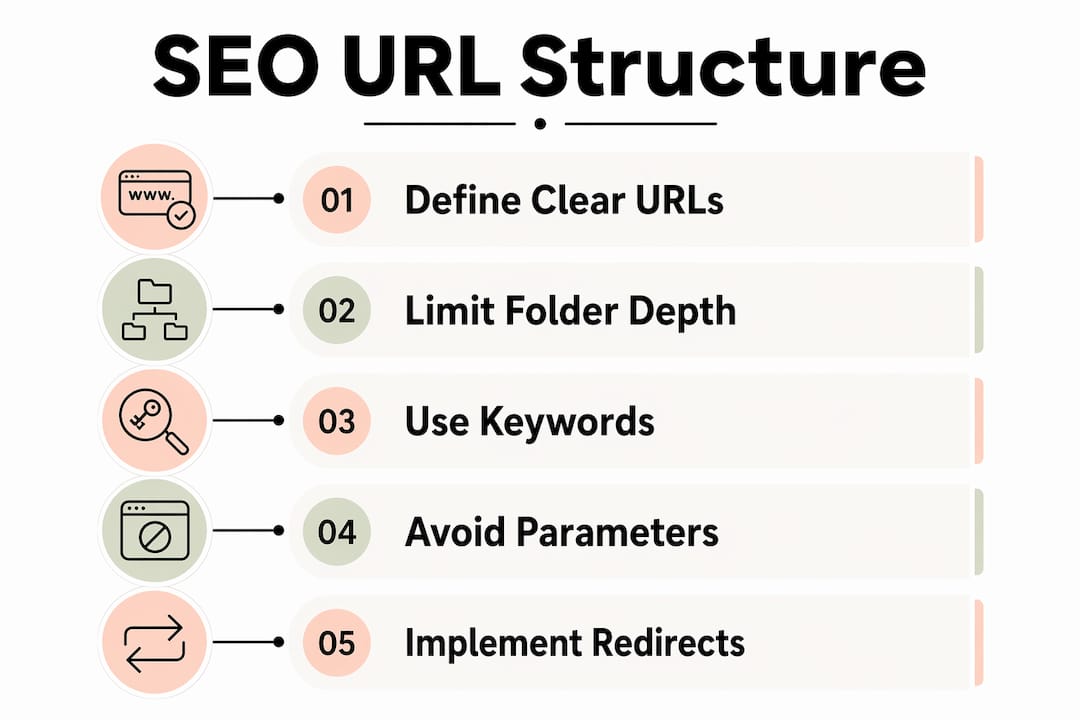
Users judge a URL before they click it. In Google Search results, the URL appears directly beneath the page title, and shorter descriptive URLs improve user trust and click-through rates because visitors can see at a glance what a page contains. A URL that reads /services/roof-repairs is immediately credible. A URL that reads /node/4821 tells the visitor nothing and raises doubt.
This matters even more when URLs are shared directly, whether in an email, a WhatsApp message, or a printed flyer. A readable URL carries its own context. An opaque one requires the recipient to trust the sender entirely before clicking.
“URL structure today is viewed as part of a website’s semantic identity, helping machines interpret relationships between content and services.” — AP News
Four practical principles for user-friendly URLs:
- Use real words, not IDs. Replace
/product/8823with/products/oak-dining-table. The second version tells the user exactly what they will find. - Keep slugs short and specific. Three to five words is the target. Avoid filler words like “the”, “a”, or “and” where they add no meaning.
- Reflect your site navigation. If your menu has a “Case Studies” section, the URL path should include
/case-studies/. Consistency between navigation labels and URL paths reduces cognitive friction. - Avoid dates in URLs for evergreen content. A URL containing
/2019/blog/how-to-fix-boilersignals to users that the content may be outdated, even if it has been updated. Use/blog/how-to-fix-boilerinstead and update the page content directly.
The homepage structure of a site sets the tone for the entire URL hierarchy beneath it. If the top level is logical and descriptive, the pages below it tend to follow suit.
What are the SEO benefits of optimised URLs, and what mistakes should you avoid?
Optimised URLs carry keywords in a position that search engines weight meaningfully. When a page’s URL contains the target phrase, it reinforces the relevance signal already present in the title tag and heading. Optimal URL length is three to five descriptive words using lowercase letters and hyphens to separate words. URLs exceeding 115 characters correlate with lower average rankings, so brevity is not just a usability preference. It is a ranking factor.
The hyphen versus underscore distinction is one of the most overlooked details in URL construction. Google treats hyphens as word separators but underscores as joiners. This means boiler-repair is read as two distinct keywords, while boiler_repair is read as a single compound string. For keyword relevance, hyphens win every time.
| URL pattern | SEO impact | Recommended? |
|---|---|---|
/services/boiler-repair |
Clear hierarchy, keyword-rich, crawlable | Yes |
/services/boiler_repair |
Keywords joined, reduced relevance signal | No |
/services/?id=44&type=repair |
No keyword signal, duplicate risk | No |
repairs.yoursite.co.uk/boiler |
Subdomain splits domain authority | Avoid unless necessary |
/services/boiler-repair/emergency-callout |
Three levels, still descriptive | Yes, if justified |
Subfolders outperform subdomains for SEO because they consolidate domain authority within a single root domain. Moving a blog from blog.yoursite.co.uk to yoursite.co.uk/blog keeps all link equity in one place. Subdomains are treated as separate entities by Google, which means any backlinks pointing to them do not strengthen the main domain.
URL changes without proper 301 redirects are one of the most damaging mistakes a business can make. 301 redirects pass ranking power and backlink equity to the new URL, while 302 redirects do not. Redesigning a site and changing URL slugs without a redirect map can erase years of accumulated SEO value overnight.
Pro Tip: Before any website redesign, export a full list of your current URLs from Google Search Console. Map every old URL to its new equivalent and implement 301 redirects before the new site goes live. This single step prevents the majority of post-redesign ranking drops.
How to plan and maintain your URL structure for ongoing SEO success
URL planning should happen before a single page is built, not after. Ignoring URL planning during redesigns risks visibility loss and authority dilution that can take months to recover. The most effective approach is to map out your site’s content categories, services, and locations first, then assign URL paths that reflect that hierarchy logically.
Practical steps for building and maintaining a sound URL structure:
- Audit existing URLs before any migration. Use Google Search Console or a crawl tool to identify which URLs currently receive traffic or backlinks. These are the pages that need redirect mapping.
- Define your folder structure before writing content. Decide whether service pages sit under
/services/, location pages under/locations/, and blog posts under/blog/. Consistency across the site makes future additions predictable. - Use canonical tags to manage duplicates. Where parameter variants are unavoidable, such as filtered product pages or tracking URLs, canonical tags tell Google which version to index. This prevents duplicate content penalties without requiring you to block URLs entirely.
- Monitor for URL drift. Content management systems like WordPress can generate unexpected URL variants through category archives, tag pages, or pagination. Regular audits using Google Search Console catch these before they accumulate.
- Keep slugs updated when content changes significantly. If a page originally titled “Boiler Repair Tips 2020” has been rewritten as a comprehensive 2026 guide, updating the slug to
/blog/boiler-repair-guideand redirecting the old URL is worth the effort.
URL structure must be a core part of website design and migration planning. Marketers who treat it as a post-launch concern consistently find themselves managing avoidable ranking drops and crawl errors.
URL structure also plays a direct role in how AI systems interpret your site. Machine-First Architecture treats URLs as explicit declarations of page identity and hierarchy, helping AI crawlers and large language models understand what a page is about before they read a single word of content. As AI-driven search continues to grow, this signal becomes more valuable, not less.
Pro Tip: When planning service or location pages, use a consistent URL pattern such as /services/[service-name] or /locations/[town-name]. This makes the site easier to extend and gives search engines a clear content taxonomy to follow.
Key takeaways
URL structure directly determines how well search engines index your site, how much users trust your pages, and how effectively your domain authority consolidates over time.
| Point | Details |
|---|---|
| Crawlability depends on URL clarity | Descriptive path segments help Googlebot index the right pages efficiently and avoid wasting crawl budget. |
| Hyphens beat underscores | Google reads hyphens as word separators, making keywords in URLs more recognisable and relevant. |
| Subfolders consolidate authority | Keeping content under one root domain rather than subdomains preserves link equity and ranking power. |
| 301 redirects are non-negotiable | Any URL change without a 301 redirect destroys the SEO equity built by that page over time. |
| Plan URLs before you build | Defining folder structure and slugs at the design stage prevents costly restructuring and ranking loss later. |
URL structure: what experience has taught me
I have worked with enough UK service businesses to say with confidence that URL structure is the most consistently underestimated technical SEO factor. Most business owners focus on content, design, and backlinks, which are all legitimate priorities. But the URL layer underpins all of it. A well-written service page sitting at a messy, parameter-laden URL is harder to rank, harder to share, and harder for Google to trust.
The mistake I see most often is URL structure being decided by a developer at the point of build, without any input from the person responsible for SEO or marketing. Developers default to whatever the CMS generates, which is often fine for functionality but poor for search visibility. The result is a site where blog posts live at /post/1234, services sit at /page?id=service-plumbing, and there is no consistent folder logic anywhere.
The intersection with Machine-First Architecture is something I find genuinely interesting. As AI systems increasingly parse websites to answer user queries directly, the URL becomes a primary identity signal. A page at /services/emergency-boiler-repair-london tells an AI exactly what the page covers, who it serves, and where. A page at /node/892 tells it nothing. The businesses that get cited by AI search tools in 2026 will be the ones whose sites are structured for machine readability, not just human browsing.
My practical advice: bring your SEO or marketing lead into the URL planning conversation before the developer starts building. Agree on a folder taxonomy, a slug convention, and a redirect policy. That conversation takes an hour and saves months of remedial work.
— Ben
How gtwelve helps you get URL structure right from the start

At gtwelve, URL structure is built into every website project from day one, not bolted on afterwards. We work with UK service businesses, trades, and SMEs to design professional websites where every page has a clear, crawlable URL that supports both search visibility and user trust. That includes defining folder taxonomies, writing descriptive slugs, mapping redirects during migrations, and auditing for parameter issues and duplicate content. If your current site has grown without a clear URL strategy, or you are planning a redesign and want to protect your existing rankings, get in touch with gtwelve to discuss a structured approach.
FAQ
What is URL structure in SEO?
URL structure in SEO refers to how a website’s page addresses are organised, including folder paths, slugs, and parameters. Search engines use URL path segments to understand page hierarchy and content relevance.
How does URL structure affect search rankings?
URL path segments inform crawlers about categories and page relevance, and keyword-containing URLs reinforce on-page relevance signals. URLs exceeding 115 characters correlate with lower average rankings.
Should I use subfolders or subdomains for my blog?
Subfolders outperform subdomains for SEO because they keep all link equity within the root domain. Use yoursite.co.uk/blog rather than blog.yoursite.co.uk wherever possible.
What happens if I change my URLs without redirects?
Changing URLs without 301 redirects causes the original page to lose all its accumulated ranking power and backlink equity. The new URL starts from zero, and any links pointing to the old address return a 404 error.
How often should I audit my website’s URLs?
A URL audit using Google Search Console every three to six months is sufficient for most small business websites. Audits should also be conducted before and after any significant content changes or site migrations.
Recommended
If this sounds like your website, we can take a look.
Note 50 of 72